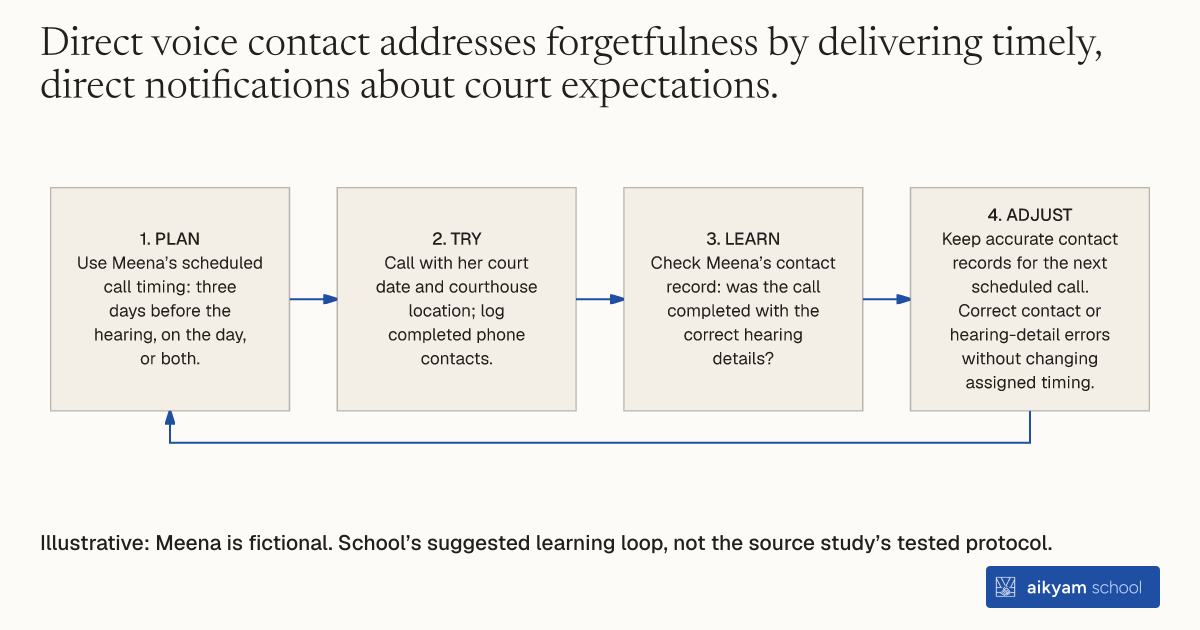
Try, learn and adjust
Check live calls convey hearing details
- Plan: Use Meena’s scheduled call timing: three days before the hearing, on the day, or both.
- Try: Call with her court date and courthouse location; log completed phone contacts.
- Learn: Check Meena’s contact record: was the call completed with the correct hearing details?
- Adjust: Keep accurate contact records for the next scheduled call. Correct contact or hearing-detail errors without changing assigned timing.
Illustrative: Meena is fictional. School’s suggested learning loop, not the source study’s tested protocol.
See source →School’s suggested, untested loop. Observe completed calls and hearing details; attendance is not assumed.
How
When to use
Long waiting periods between receiving a summons and a scheduled court appearance often lead defendants to forget critical hearing details. Missing a court appearance results in costly warrants, legal penalties, or arrest. Placing direct telephone calls to individuals awaiting trial reminds them of scheduled hearing dates and locations.
Place direct phone calls to individuals awaiting pretrial court appearances to remind them of their scheduled date and courthouse location.
- Court program staff obtain upcoming hearing schedules and phone numbers for individuals awaiting court processing.
- Staff initiate telephone calls either three days before the court appearance, the day of the court appearance, or at both times.
- Callers verbally inform defendants of their scheduled court date and specific courthouse location.
- Staff log completed phone contacts and update participant records in the court tracking database.
Why it works
Direct communication helps defendants remember hearing details and prepare necessary travel plans.
Example
In New York state, program staff placed reminder phone calls to individuals awaiting court processing, which reduced failure to appear rates from approximately 19 percent to 12 percent and avoided 600 warrants over a year.
About the study
Participants
Individuals awaiting court processing and scheduled court appearances in New York state.
Study Design
Randomized evaluation comparing defendants receiving live phone calls (three days prior, same day, or both) against a comparison group receiving no calls.
Results
Receiving a phone call at any time decreased failure to appear rates from approximately 19 percent to 12 percent, representing a 37 percent relative reduction, and cost US\$34 per avoided warrant while averting 600 warrants annually.