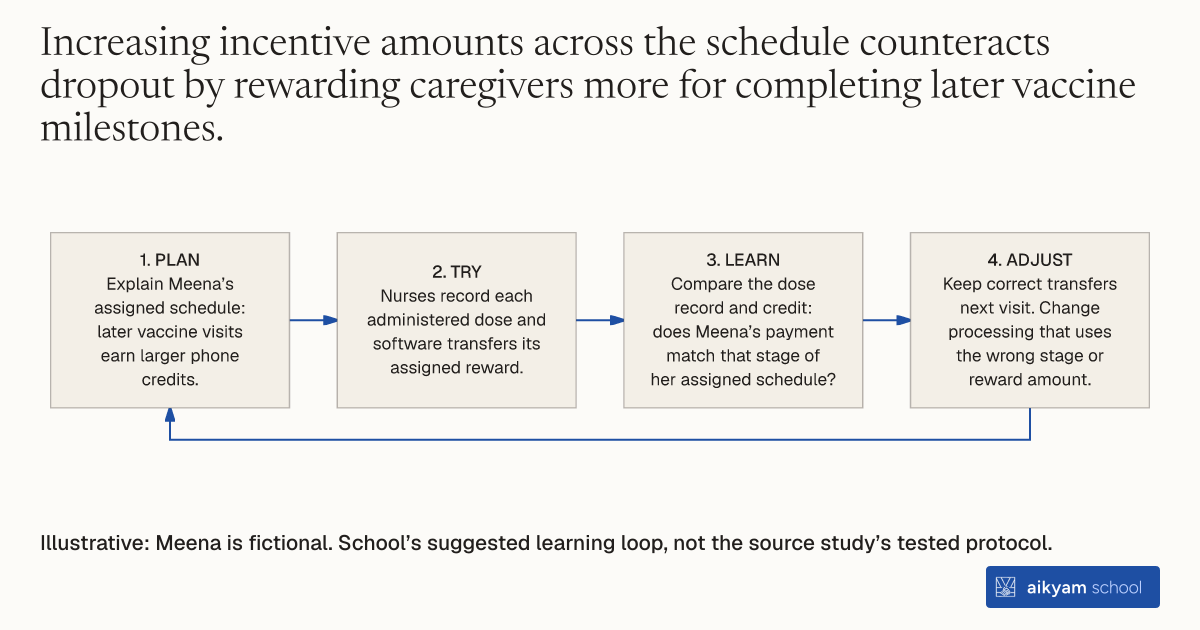
Try, learn and adjust
Check increasing credits follow the schedule
- Plan: Explain Meena’s assigned schedule: later vaccine visits earn larger phone credits.
- Try: Nurses record each administered dose and software transfers its assigned reward.
- Learn: Compare the dose record and credit: does Meena’s payment match that stage of her assigned schedule?
- Adjust: Keep correct transfers next visit. Change processing that uses the wrong stage or reward amount.
Illustrative: Meena is fictional. School’s suggested learning loop, not the source study’s tested protocol.
See source →School’s suggested, untested loop. Observe dose entries and the assigned increasing credit schedule. Combined-package effects are not incentive-only effects.
How
When to use
Caregivers often start their children on an immunization schedule but drop out before completing later doses. Fixed transfers may not overcome the growing friction caregivers face as time passes. Deploy this method to offer mobile phone credit rewards that increase in value with each completed vaccine dose.
Structure mobile phone credit transfers to grow in value across a child's immunization schedule to encourage full vaccination completion.
- Clinic managers establish a payment schedule where later vaccine doses earn higher mobile phone credits than earlier doses.
- Auxiliary nurse midwives inform parents during clinic visits about the growing monetary reward for each subsequent vaccine.
- Caregivers bring their infants under twelve months old to free monthly village health sessions for scheduled immunizations.
- Auxiliary nurse midwives log each administered vaccine on a clinic software platform tied to the caregiver's mobile phone number.
- Software automatically transfers mobile phone credits to the caregiver's phone, increasing the payout amount upon completion of later doses.
Why it works
When combined with reminders and ambassadors, progressive rewards sustain motivation through the final required dose.
Example
In Haryana, India, researchers tested high increasing incentives paying INR 50 for the first three immunizations, 100 for the fourth, and 200 for the fifth, alongside low increasing incentives paying INR 10 for the first three, 60 for the fourth, and 160 for the fifth.
About the study
Participants
Caregivers of children under twelve months of age across 70 primary health centers in Haryana, India.
Study Design
A randomized controlled trial evaluating increasing mobile phone credit structures against flat credits and control groups across 75 cross-randomized policy packages.
Results
Combining community-nominated information hubs, SMS reminders, and increasing incentives increased full immunization rates by 55 percent relative to the comparison group.