Research procedure
Survey gender attitudes and behaviour
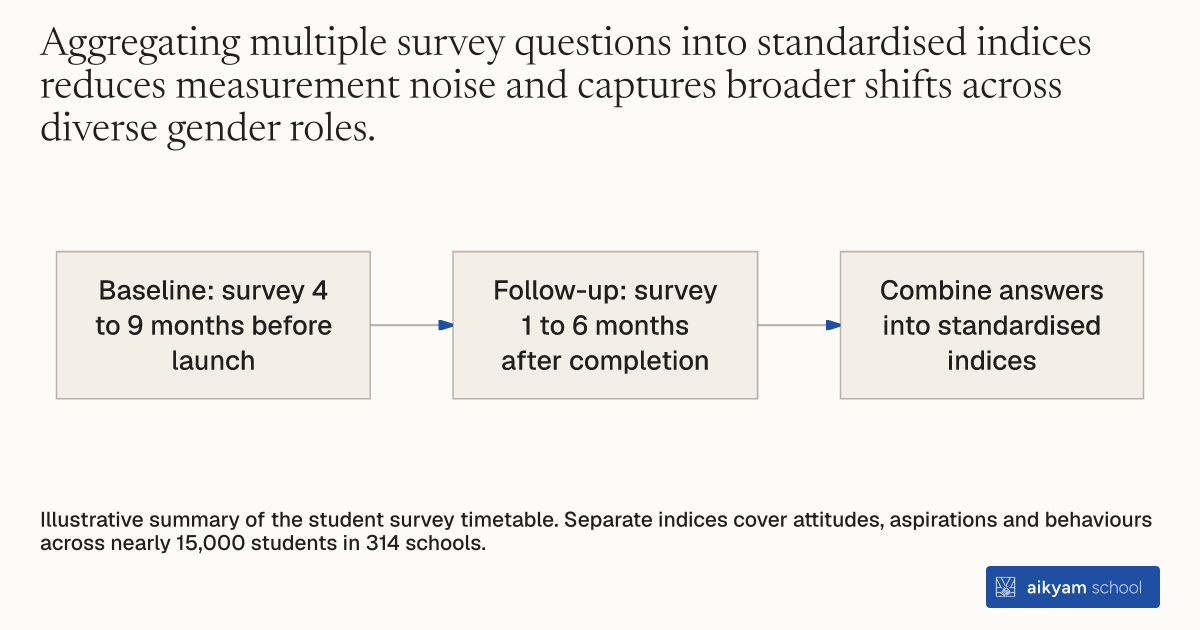
- Baseline: survey 4 to 9 months before launch
- Follow-up: survey 1 to 6 months after completion
- Combine answers into standardised indices
Illustrative summary of the student survey timetable. Separate indices cover attitudes, aspirations and behaviours across nearly 15,000 students in 314 schools.
See source →How
When to use
Evaluating adolescent gender programs requires measuring subtle subjective views, future goals, and everyday behaviors. This method provides a structured survey design that aggregates specific student responses into standardised indices. It serves evaluators and researchers measuring multi-dimensional attitude and behavior shifts among secondary school students.
Administer structured surveys to secondary school students before and after an intervention to measure changes across distinct gender dimensions.
- Evaluators design survey instruments with targeted questions covering personal attitudes, career aspirations, and household behaviors.
- Field researchers administer baseline surveys to enrolled students four to nine months before program launch.
- Field researchers ask students about views on female employment, property rights, educational equality, and daily household chores.
- Field researchers conduct follow-up surveys one to six months after program completion.
- Evaluators aggregate individual question responses into standardised indices for gender attitudes, aspirations, and behaviors.
Why it works
Pre- and post-program surveying isolates specific changes in personal views from broader social norms and daily actions.
Example
Researchers surveyed nearly 15,000 students in grades 7–8 across 314 government schools in Haryana, India, before and after a two-and-a-half-year program. The survey revealed a 0.25 standard deviation increase in the gender attitude index and a 0.32 standard deviation increase in the gender behavior index.
About the study
Participants
Nearly 15,000 students in grades 7–8 (aged 11–15) across 314 government schools in Haryana, India.
Study Design
School-level cluster randomized controlled trial with student surveys administered 4–9 months pre-intervention and 1–6 months post-intervention.
Results
Gender attitude index increased by 0.25 standard deviations, gender behavior index increased by 0.32 standard deviations (0.46 for boys, 0.21 for girls), and female employment support increased by 12.9 percentage points.