Research procedure
Survey parental views before the programme
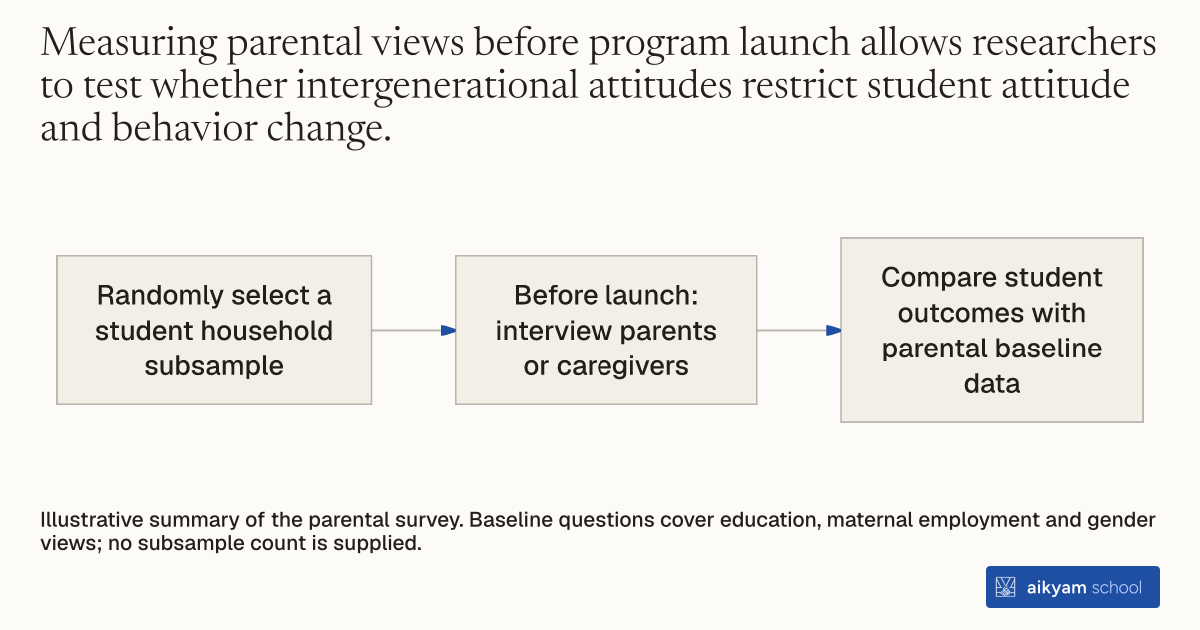
- Randomly select a student household subsample
- Before launch: interview parents or caregivers
- Compare student outcomes with parental baseline data
Illustrative summary of the parental survey. Baseline questions cover education, maternal employment and gender views; no subsample count is supplied.
See source →How
When to use
Adolescents' social attitudes form within household environments shaped by parental beliefs. This method evaluates how baseline parental views and demographic backgrounds influence student program outcomes. It serves evaluators and researchers measuring household-level moderators in social norm interventions.
Survey a representative subsample of participants' parents before starting an intervention to evaluate household baseline factors.
- Evaluators select a random subsample of enrolled students' households prior to program implementation.
- Field researchers visit selected households to conduct baseline interviews with parents or primary caregivers.
- Field researchers ask questions regarding parental education levels, maternal labor force participation, and gender views.
- Evaluators record parental literacy rates and workplace status to establish baseline household demographics.
- Evaluators compare post-intervention student results against parental baseline data to assess whether household views moderate impact.
Why it works
It isolates student-level shifts from underlying household demographics and parental influence.
Example
Researchers surveyed a subsample of parents prior to Breakthrough's program in Haryana, India, finding 37 percent of mothers were illiterate and 29 percent worked outside the home. The evaluation showed that parental gender attitudes had no overall impact on how the program changed student outcomes.
About the study
Participants
Subsample of parents of students enrolled across 314 government schools in Haryana, India.
Study Design
Baseline parental subsample survey integrated into a school-level cluster randomized controlled trial.
Results
Baseline data showed 37 percent of mothers were illiterate and 29 percent worked outside the home, while analysis proved parental gender attitudes had no impact on program success on average.