Try, learn and adjust
Check where informal seed exchanges reach
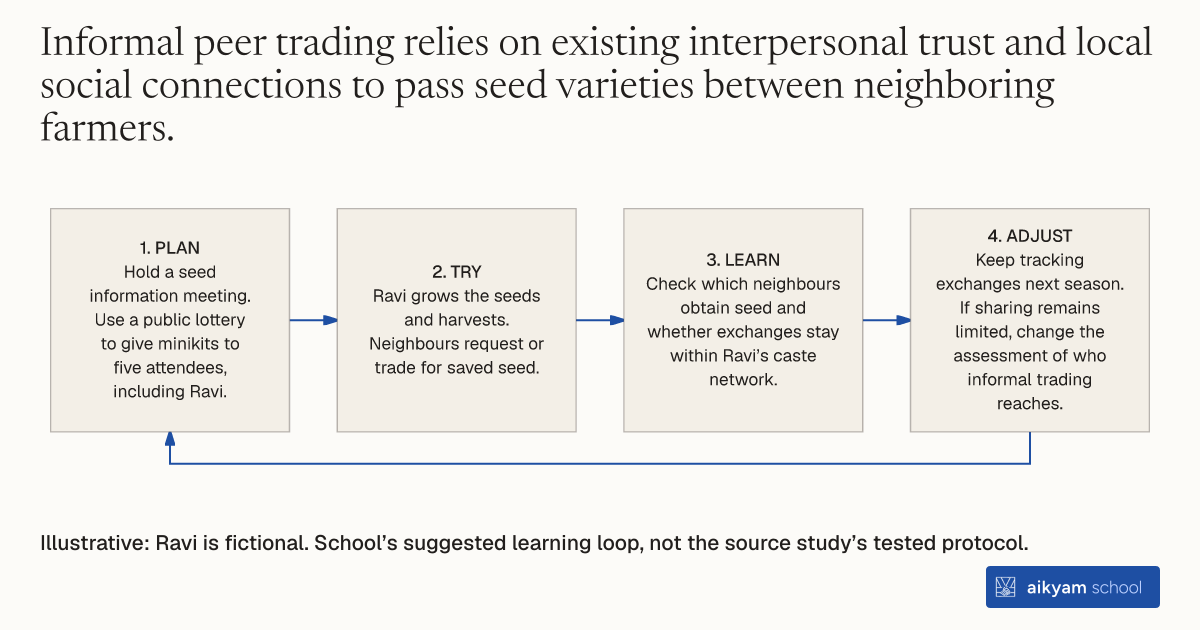
- Plan: Hold a seed information meeting. Use a public lottery to give minikits to five attendees, including Ravi.
- Try: Ravi grows the seeds and harvests. Neighbours request or trade for saved seed.
- Learn: Check which neighbours obtain seed and whether exchanges stay within Ravi’s caste network.
- Adjust: Keep tracking exchanges next season. If sharing remains limited, change the assessment of who informal trading reaches.
Illustrative: Ravi is fictional. School’s suggested learning loop, not the source study’s tested protocol.
See source →School’s suggested learning loop: observe seed exchanges and social barriers; informal sharing does not guarantee broad access.
How
When to use
Smallholder farmers in rural villages often lack direct access to formal commercial seed markets. Informal peer-to-peer seed trading allows farmers who obtain new seed varieties to share or trade them directly with neighboring farmers. It tests whether local social networks alone can naturally spread improved agricultural technology across a community.
Encourage village farmers to trade and share new seed varieties within their local social networks.
- Program officers organize a village meeting to present information about the benefits of Swarna-Sub1 rice seeds.
- Meeting organizers run a public lottery at the end of the meeting to distribute seed minikits to five selected attendees.
- Recipient farmers cultivate the seeds and harvest their crop at the end of the season.
- Neighboring farmers request or trade for saved seeds directly from the initial minikit recipients.
- Minikit recipients sell or share a portion of their harvested seeds with peer farmers through informal social exchanges.
Why it works
However, social divisions and trading frictions frequently restrict informal exchanges primarily to farmers within the same caste network.
Example
In 82 villages in Bhadrak district, Odisha, researchers distributed minikits to five meeting attendees via public lottery and tracked peer-to-peer seed trading. One year after introduction, informal peer sharing achieved a seed adoption rate of 7 percent among non-recipient farmers.
About the study
Participants
82 villages in Bhadrak district, Odisha, India.
Study Design
Randomized evaluation tracking rates of Swarna-Sub1 seed trading between farmers following informational village meetings and public lottery distribution of minikits to five attendees.
Results
One year after introducing seeds, adoption of Swarna-Sub1 through informal peer-to-peer sharing reached 7 percent (compared to 40 percent under direct door-to-door sales).