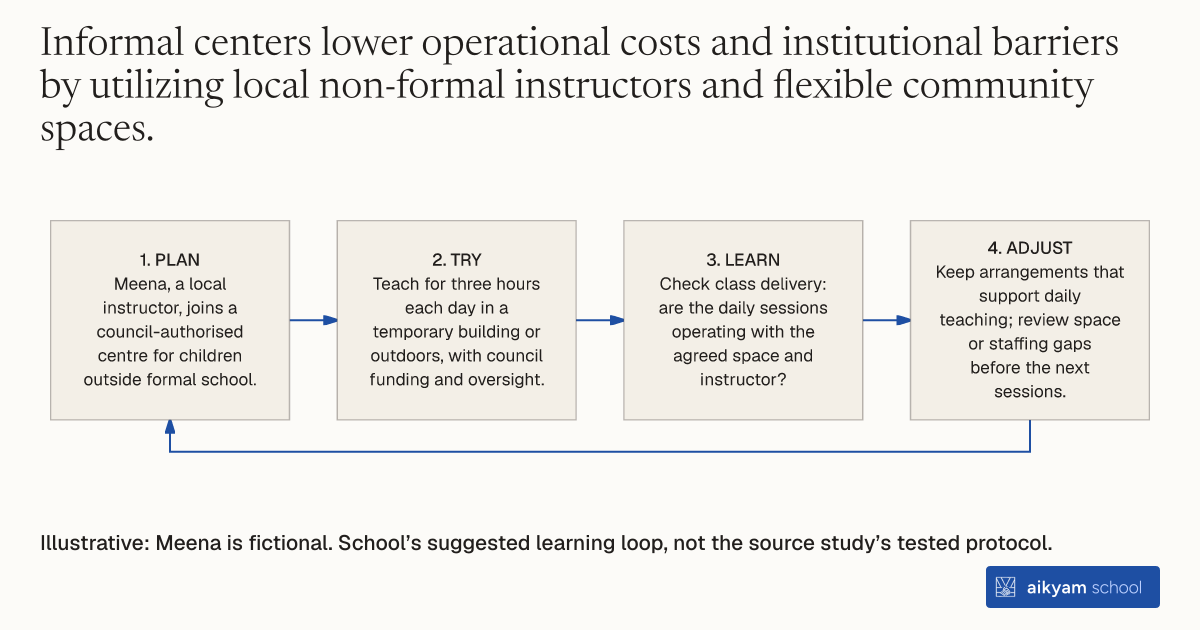
Try, learn and adjust
Check delivery of informal primary classes
- Plan: Meena, a local instructor, joins a council-authorised centre for children outside formal school.
- Try: Teach for three hours each day in a temporary building or outdoors, with council funding and oversight.
- Learn: Check class delivery: are the daily sessions operating with the agreed space and instructor?
- Adjust: Keep arrangements that support daily teaching; review space or staffing gaps before the next sessions.
Illustrative: Meena is fictional. School’s suggested learning loop, not the source study’s tested protocol.
See source →School’s suggested loop, not a tested source procedure. Observe sessions, staffing and council oversight; do not infer learning gains.
How
When to use
Rural children frequently drop out or fail to attend formal primary schools due to fixed schedules and teacher qualification requirements. This intervention establishes community-managed informal education centers to provide flexible basic schooling. It serves local village councils seeking to expand primary education access for out-of-school children.
Establish and operate village-level informal education centers to provide basic schooling for out-of-school children.
- Authorize the local village council to establish an informal education center in underserved communities.
- Recruit a local instructor who is not required to possess formal teaching qualifications.
- Secure a temporary building or outdoor space within the village to host daily class sessions.
- Schedule instructional sessions for three hours each day tailored to out-of-school children.
- Provide administrative oversight and local public funding through the village council governance framework.
Why it works
This enables local governments to rapidly provide basic instruction where formal schooling infrastructure is absent.
Example
Village councils across West Bengal established and operated Shishu Shiksha Kendra informal education centers, with 82% of unreserved councils operating a center compared to 67% of female-headed reserved councils.
About the study
Participants
Survey of 161 Village Councils (323 sample villages) in Birbhum district, West Bengal.
Study Design
Randomized policy experiment evaluating public good investments and school administration across reserved female-headed councils and unreserved control councils.
Results
Reserved female-headed councils were 16 percentage points less likely to have an informal education center at the council level (67% in reserved vs 82% in unreserved) and had 0.06 fewer education centers per village (0.06 in reserved vs 0.12 in unreserved).