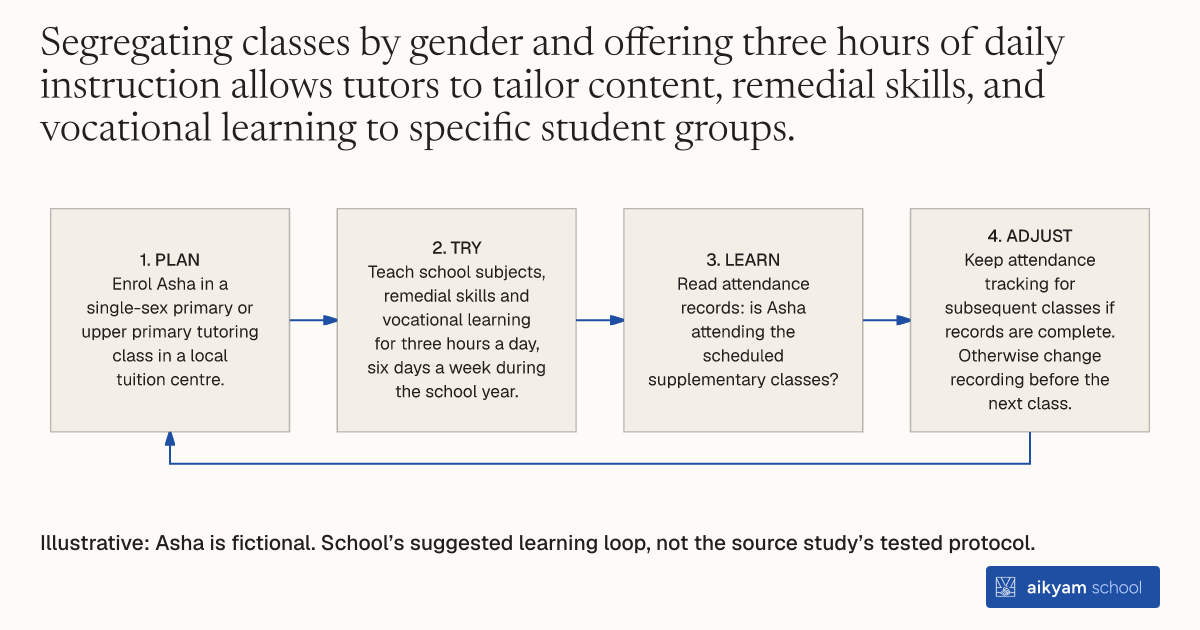
Try, learn and adjust
Check supplementary classes follow the tutoring schedule
- Plan: Enrol Asha in a single-sex primary or upper primary tutoring class in a local tuition centre.
- Try: Teach school subjects, remedial skills and vocational learning for three hours a day, six days a week during the school year.
- Learn: Read attendance records: is Asha attending the scheduled supplementary classes?
- Adjust: Keep attendance tracking for subsequent classes if records are complete. Otherwise change recording before the next class.
Illustrative: Asha is fictional. School’s suggested learning loop, not the source study’s tested protocol.
See source →School’s suggested learning loop, not a source-tested procedure. Observe the class schedule and attendance. The study found no test score impact in maths or English.
How
When to use
Primary and upper primary school students in low-income urban areas often require additional academic support. Standard classroom instruction may leave pupils struggling with typical school subjects and basic remedial skills. Setting up gender-segregated tuition centers provides dedicated supplementary instruction tailored to young learners.
Deliver supplementary academic tutoring to primary and upper primary school students using gender-segregated tuition centers during the school year.
- Educational NGOs set up local tuition centers in urban low-income neighborhoods.
- Staff separate enrolling primary and upper primary school students into single-sex classes for boys and girls.
- Instructors schedule classes for three hours per day, six days a week throughout the school year.
- Tutors teach typical school subjects alongside remedial skills and vocational learning at the tuition center.
Example
Pratham operated tuition centers in 21 low-income neighborhoods in Delhi, India, holding 3-hour classes 6 days a week for 5,439 upper primary school students.
About the study
Participants
5,439 upper primary school children from 21 low-income neighborhoods in Delhi, India, where 10 percent of students attended private school and mothers averaged 3.7 years of education.
Study Design
Researchers conducted a randomized evaluation with Pratham between April 2014 and the 2014-2015 school year tracking enrollment, attendance, and child test scores in math and English.
Results
Sixty-nine percent of students offered free tutoring enrolled, but charging INR 100 caused enrollment to drop by around 17 percentage points, and tutoring sessions had no impact on test scores in math or English.