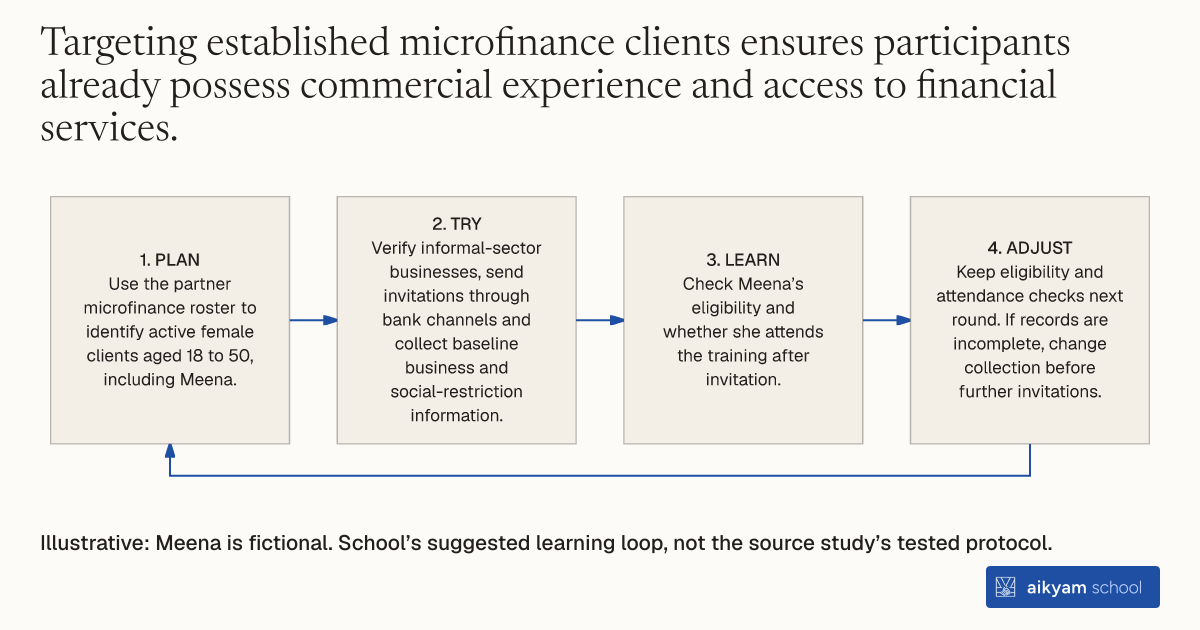
Try, learn and adjust
Check invitations reach eligible women entrepreneurs
- Plan: Use the partner microfinance roster to identify active female clients aged 18 to 50, including Meena.
- Try: Verify informal-sector businesses, send invitations through bank channels and collect baseline business and social-restriction information.
- Learn: Check Meena’s eligibility and whether she attends the training after invitation.
- Adjust: Keep eligibility and attendance checks next round. If records are incomplete, change collection before further invitations.
Illustrative: Meena is fictional. School’s suggested learning loop, not the source study’s tested protocol.
See source →School’s suggested learning loop: observe eligibility, invitations and attendance; attendance does not establish business expansion.
How
When to use
Women micro-entrepreneurs in the urban informal sector often face low baseline earnings and high social restrictions. Microfinance institutions and development organizations struggle to recruit active female entrepreneurs for business training. Target female microfinance bank clients operating informal businesses to reach women who can expand commercial activities.
Identify and recruit female informal sector entrepreneurs through microfinance client rosters for business training programs.
- Partner with a microfinance institution serving low-income women in urban informal markets.
- Filter the client database to select active female clients between the ages of 18 and 50.
- Verify that selected clients run micro-enterprises in informal trades like vending, tailoring, and manufacturing.
- Issue program invitations directly through microfinance bank channels to selected clients.
- Survey selected women to collect baseline data on business performance and social restrictions.
Why it works
This targeting allows business education programs to build directly on existing enterprises.
Example
Researchers partnered with the Self-Employed Women's Association Bank in Ahmedabad, India, to select 636 female clients between 18 and 50 years old. The targeted women worked in informal sector trades and earned a median income of about one dollar per day. Seventy percent of invited clients attended the two-day training program.
About the study
Participants
636 female microfinance clients aged 18 to 50 in Ahmedabad, India.
Study Design
Randomized controlled trial targeting active clients of SEWA Bank in urban informal markets.
Results
Targeting SEWA Bank clients achieved a 70 percent training attendance rate among invited women, who earned a median baseline income of roughly \$1 per day.