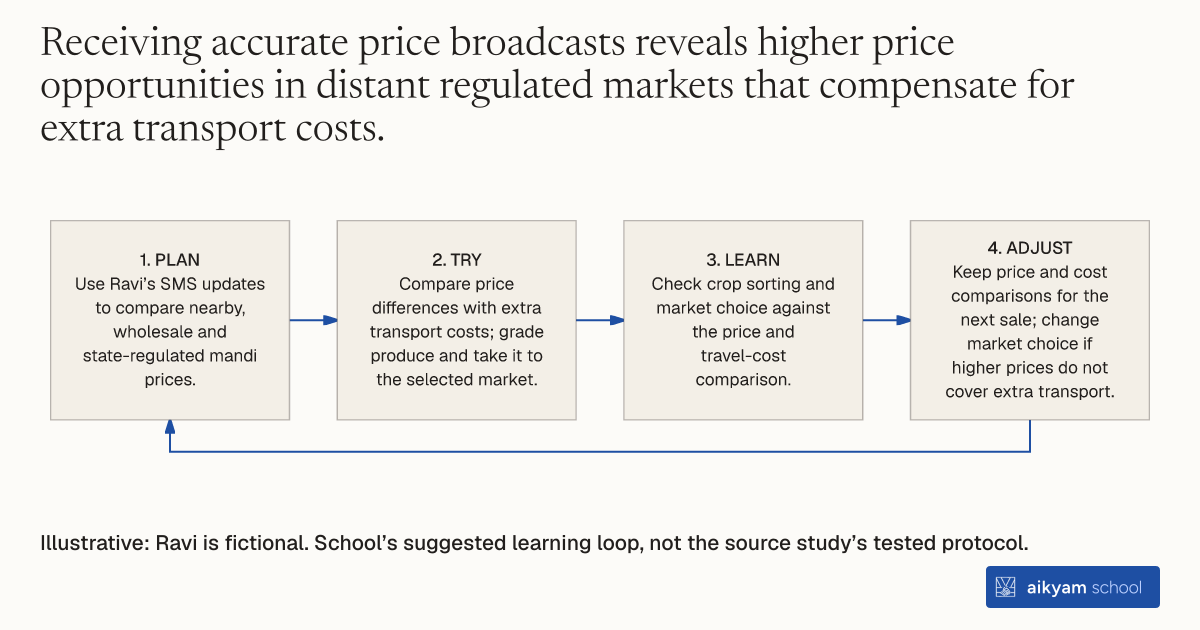
Try, learn and adjust
Check market choices account for transport costs
- Plan: Use Ravi’s SMS updates to compare nearby, wholesale and state-regulated mandi prices.
- Try: Compare price differences with extra transport costs; grade produce and take it to the selected market.
- Learn: Check crop sorting and market choice against the price and travel-cost comparison.
- Adjust: Keep price and cost comparisons for the next sale; change market choice if higher prices do not cover extra transport.
Illustrative: Ravi is fictional. School’s suggested learning loop, not the source study’s tested protocol.
See source →School’s suggested learning loop; not a tested source procedure. Observe grading, selling location and transport costs. The source reports no overall change in average prices received.
How
When to use
Smallholder farmers frequently sell unsorted produce at nearby local markets or on their own farms for lower prices. They lack knowledge of regional price differentials and regulated mandi prices. Referencing SMS market updates allows producers to sort crops by quality and select higher-paying distant trading venues.
Grade harvested produce and choose selling locations using SMS market price updates.
- Farmer receives SMS messages containing price updates for local and regional markets.
- Farmer compares prices listed across nearby markets, distant wholesale markets, and state-regulated mandis.
- Farmer determines whether selling at a more distant market covers additional travel and transport costs.
- Farmer sorts and grades harvested crops into distinct quality tiers based on market standards.
- Farmer transports the sorted crops to the selected distant wholesale market or mandi to sell.
Why it works
Sorting produce into quality categories allows farmers to align crop grades with market standards and demand.
Example
Subscribed smallholder farmers across 100 villages in central Maharashtra, India referenced RML SMS price updates, leading to an increased likelihood of sorting their crops and choosing to sell output at more distant wholesale markets or state-regulated mandis rather than at local markets or on their own farms.
About the study
Participants
933 farmers in 100 villages across 5 crop districts, central Maharashtra, India.
Study Design
Randomized Controlled Trial (RCT) evaluating a 1-year Thomson-Reuters RML SMS price dissemination service across 100 villages.
Results
Subscribed farmers were 39 to 46 percent more likely to reference RML for pricing and reported an increased likelihood of grading or sorting crops and selling at more distant wholesale markets or mandis, though overall average prices received did not change.