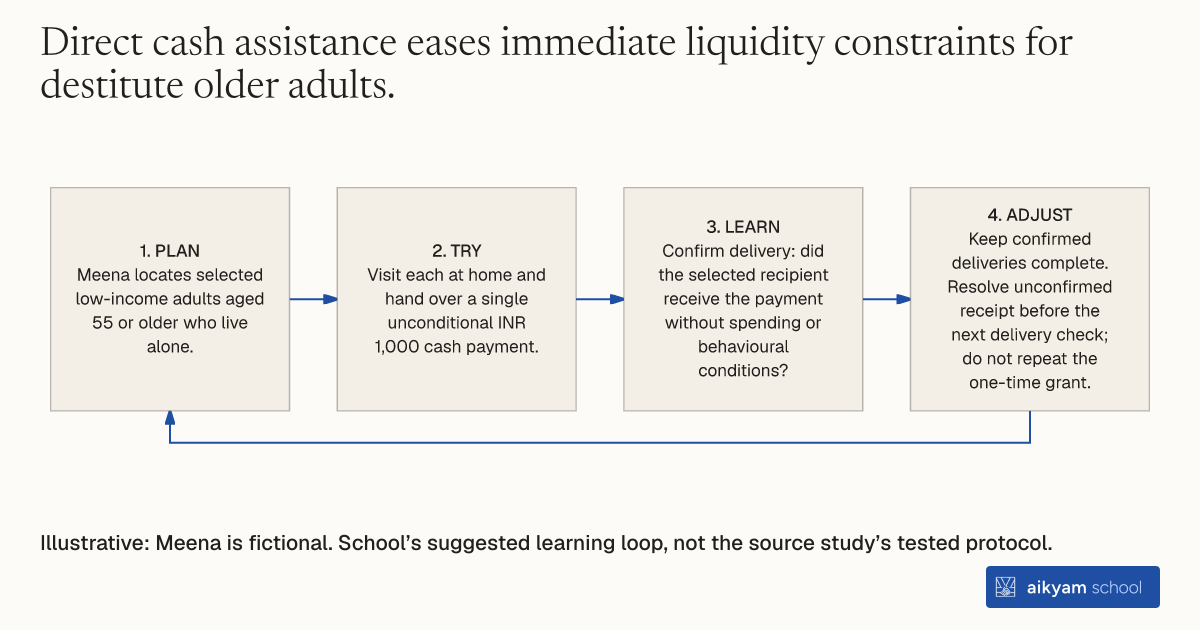
Try, learn and adjust
Check one-time cash delivery
- Plan: Meena locates selected low-income adults aged 55 or older who live alone.
- Try: Visit each at home and hand over a single unconditional INR 1,000 cash payment.
- Learn: Confirm delivery: did the selected recipient receive the payment without spending or behavioural conditions?
- Adjust: Keep confirmed deliveries complete. Resolve unconfirmed receipt before the next delivery check; do not repeat the one-time grant.
Illustrative: Meena is fictional. School’s suggested learning loop, not the source study’s tested protocol.
See source →School’s suggested learning loop checks receipt, separately from the trial’s payment. Effects measured at three weeks faded by three months.
How
When to use
Low-income older adults living alone face severe economic vulnerability and emotional strain. Monetary scarcity hinders their ability to perform daily household activities and maintain mental well-being. Distributing unconditional cash payments provides immediate financial relief to improve short-term functionality and reduce depressive symptoms.
Deliver a one-time unconditional cash transfer directly to eligible low-income older adults at their homes.
- Field personnel locate selected low-income adults aged 55 or older who live alone.
- Field personnel visit participants in person at their residences.
- Field personnel deliver a single unconditional payment of INR 1,000 cash to each participant.
- Field personnel confirm the cash delivery without requiring any spending obligations or behavioral conditions.
Why it works
Financial relief reduces everyday psychological stress and allows seniors to afford essential daily needs.
Example
In Tamil Nadu, India, researchers delivered a one-time cash transfer of INR 1,000 (US\$12 in 2021) in person to 184 low-income older adults living alone. The cash grant equaled 57 percent of baseline monthly spending and reduced functional impairment scores by 2.9 points at three weeks.
About the study
Participants
1,120 low-income adults aged 55 or older living alone in Tamil Nadu, India, with 184 assigned to the cash transfer group (average baseline monthly spending INR 1,747).
Study Design
Randomized controlled trial comparing in-person unconditional cash transfer delivery against phone-based CBT, a combined group, and a comparison group with outcomes assessed three weeks and three months later.
Results
At three weeks, cash transfer recipients experienced a 2.9-point reduction in functional impairment and a 1-point decrease in depression scores relative to the comparison group, driven by women who saw a 4.1-point reduction in functional impairment and a 1.4-point drop in depression, though effects faded by three months.