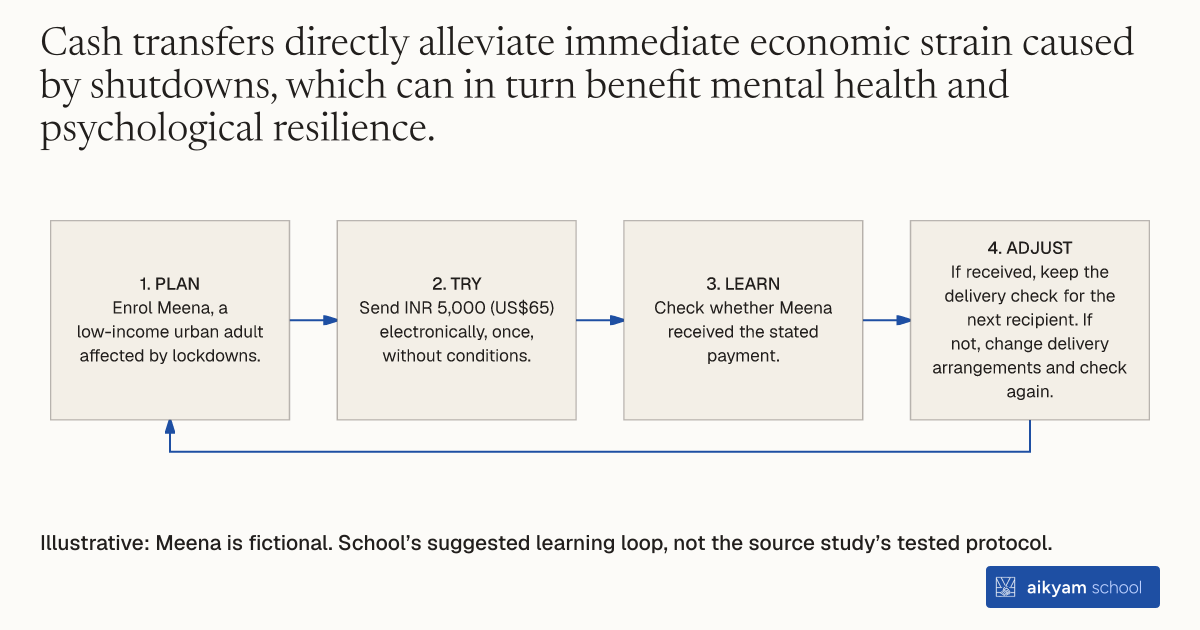
Try, learn and adjust
Check one-time cash delivery
- Plan: Enrol Meena, a low-income urban adult affected by lockdowns.
- Try: Send INR 5,000 (US$65) electronically, once, without conditions.
- Learn: Check whether Meena received the stated payment.
- Adjust: If received, keep the delivery check for the next recipient. If not, change delivery arrangements and check again.
Illustrative: Meena is fictional. School’s suggested learning loop, not the source study’s tested protocol.
See source →School’s suggested learning loop, not the source’s tested procedure. Observe receipt of the one-time payment. Research is ongoing; results are forthcoming.
How
When to use
Low-income adults in urban areas suffer severe economic strain and distress during pandemics and lockdowns. A lack of financial stability, income, and savings exacerbates their ability to navigate health and economic crises. One-time unconditional cash transfers directly relieve financial pressure and support mental well-being for vulnerable households.
Distribute a one-time unconditional cash transfer electronically to low-income adults affected by economic crises.
- Identify low-income urban adults experiencing economic strain from pandemic lockdowns.
- Enroll eligible adults into an unconditional cash transfer initiative at the start of the intervention period.
- Transfer INR 5,000 (US\$65), equivalent to about one week's salary, directly to each participant.
- Deliver funds electronically to ensure rapid and direct financial relief without requiring conditional actions.
Example
Researchers provided a one-time unconditional electronic cash transfer of INR 5,000 (US\$65) to approximately 800 low-income urban adults in Tamil Nadu, India.
About the study
Participants
Up to 2,400 urban low-income adults in Tamil Nadu, India, with approximately 800 adults in the cash transfer group.
Study Design
Randomized evaluation conducted by J-PAL South Asia and SCARF India.
Results
Research ongoing; results are forthcoming.