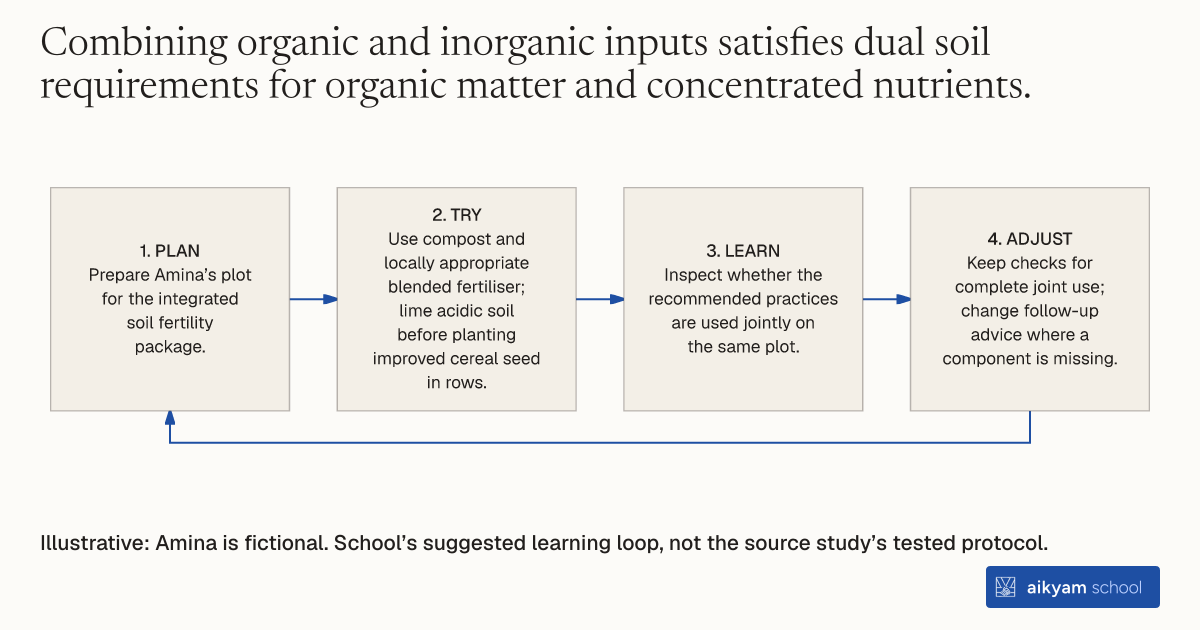
Try, learn and adjust
Check complementary practices share the same plot
- Plan: Prepare Amina’s plot for the integrated soil fertility package.
- Try: Use compost and locally appropriate blended fertiliser; lime acidic soil before planting improved cereal seed in rows.
- Learn: Inspect whether the recommended practices are used jointly on the same plot.
- Adjust: Keep checks for complete joint use; change follow-up advice where a component is missing.
Illustrative: Amina is fictional. School’s suggested learning loop, not the source study’s tested protocol.
See source →Observe same-plot use, with lime for acidic soil. The source measures package adoption, not a guaranteed yield gain. School suggests this learning loop; it was not tested by the source.
How
When to use
Smallholder farmers in developing regions often suffer from low agricultural productivity and soil degradation due to fragmented technology use. Applying individual inputs in isolation fails to achieve high potential yields. Jointly applying complementary organic and inorganic practices on the exact same field plot restores soil health and maximizes crop output.
Apply an integrated package of organic amendments, inorganic nutrients, certified seeds, and improved agronomic practices jointly on the same farm plot during the main cropping season.
- Apply organic compost produced in covered pits to improve soil structure and organic matter content.
- Apply location-specific blended fertilizer targeted to local soil nutrient deficiencies.
- Apply agricultural lime on acidic soils to reduce soil acidity before planting.
- Plant certified improved cereal seeds such as maize, wheat, teff, barley, or sorghum.
- Seed crops in distinct target rows rather than broadcasting to optimize plant spacing and allow root-targeted microdosing.
Why it works
Joint plot-level application creates positive yield synergies that single technology adoption cannot match.
Example
Smallholders across 72 microwatersheds in Amhara, Oromia, and Tigray in Ethiopia applied the ISFM quickwin package during the 2017 main cropping season. Households receiving extension alone were 8.4 percentage points more likely to adopt the full set of practices jointly on the same plot, while households receiving extension plus video achieved a 10.9 percentage point increase over the control group mean of 15.2 percent.
About the study
Participants
N = 2,160 smallholder farming households across 161 microwatersheds in Ethiopia.
Study Design
Cluster Randomized Controlled Trial with microwatersheds assigned to extension alone (T1), extension plus video (T2), or control, evaluated using probit models at endline.
Results
Extension alone increased full-package joint plot adoption by 8.4 percentage points (p < 0.01), and extension combined with video increased joint adoption by 10.9 percentage points (p < 0.01) relative to the control group mean of 15.2%.