Try, learn and adjust
Check farmer groups meet and share advice
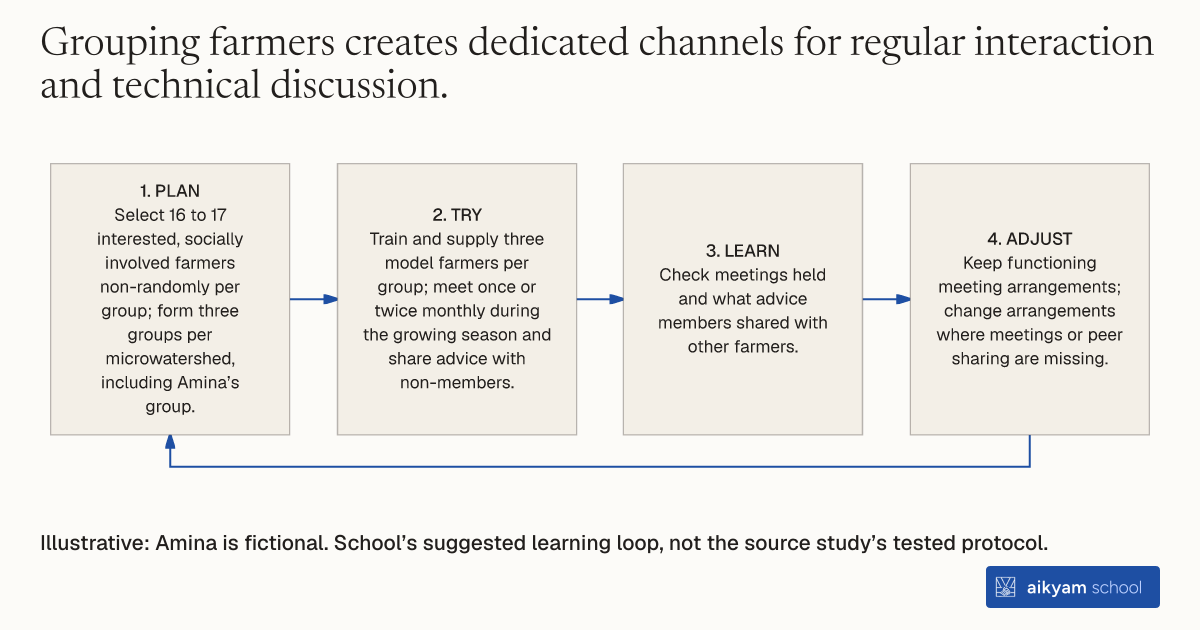
- Plan: Select 16 to 17 interested, socially involved farmers non-randomly per group; form three groups per microwatershed, including Amina’s group.
- Try: Train and supply three model farmers per group; meet once or twice monthly during the growing season and share advice with non-members.
- Learn: Check meetings held and what advice members shared with other farmers.
- Adjust: Keep functioning meeting arrangements; change arrangements where meetings or peer sharing are missing.
Illustrative: Amina is fictional. School’s suggested learning loop, not the source study’s tested protocol.
See source →Observe group formation, model farmer training, meeting frequency and peer information sharing. School suggests this learning loop; it was not tested by the source.
How
When to use
Decentralized agricultural extension systems struggle to reach rural households cost-effectively with complex technologies. Public extension agents lack capacity to train every farmer individually. Group-based structures organize local farmers into participatory learning hubs to facilitate peer-to-peer knowledge diffusion.
Establish community-based farmer research groups to facilitate participatory learning and peer technology diffusion.
- Select 16 to 17 local farmers per group non-randomly through extension agents and village heads based on interest and social involvement.
- Form three distinct groups per microwatershed to include approximately 50 participating farmers per community.
- Appoint three leading members per group as model farmers to receive direct technical training and inputs from extension agents.
- Convene group meetings once or twice per month during the main growing season to discuss agricultural techniques.
- Prompt group members to share acquired knowledge informally with non-member peer farmers across the village.
Why it works
This bottom-up structure lowers information barriers and reinforces multi-component agricultural management practices.
Example
The GIZ-ISFM+ project formed 3 groups per microwatershed across 72 communities in Amhara, Oromia, and Tigray in Ethiopia. Members met once or twice monthly during the 2016 and 2017 growing seasons to learn soil fertility techniques. Participating members increased their applied technology count by 1.232 practices and raised full-package adoption by 28 percentage points compared to matched controls.
About the study
Participants
N = 400 group members and matched controls within 2,382 rural farming households across 3 regions in Ethiopia.
Study Design
Cluster Randomized Controlled Trial at the microwatershed level using 1-to-1 nearest neighbor propensity score matching to compare group members against control farmers.
Results
Group participation under standard extension increased the number of adopted practices by 1.232 (p < 0.01) and integrated full-package adoption by 28 percentage points (p < 0.01) relative to matched controls.