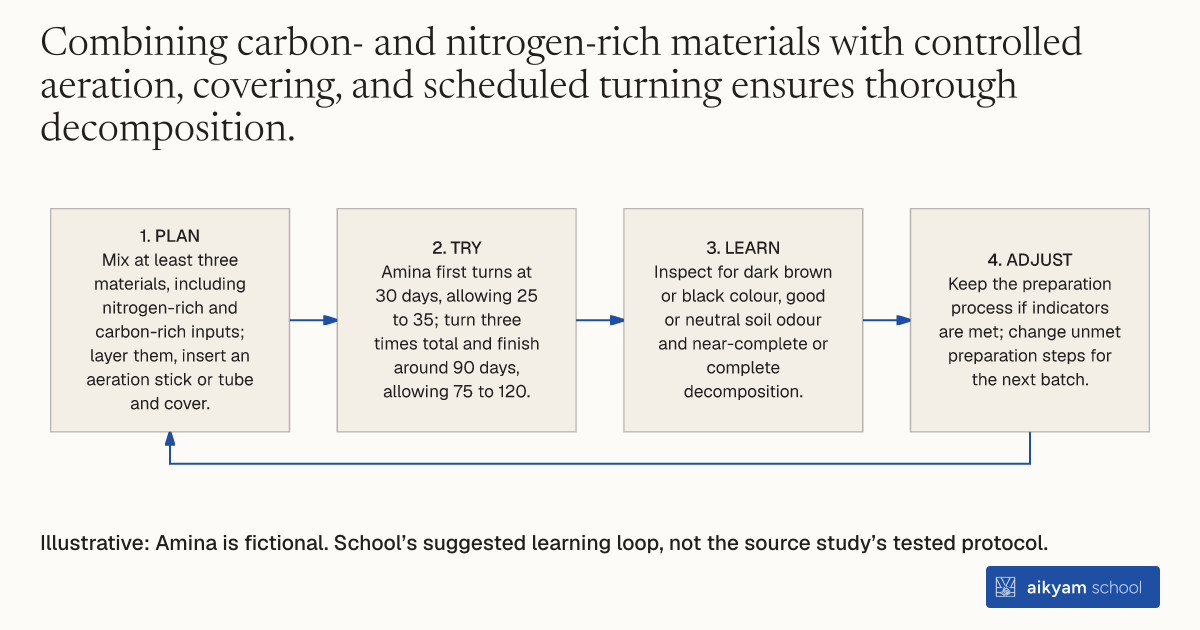
Try, learn and adjust
Check compost preparation and finished condition
- Plan: Mix at least three materials, including nitrogen-rich and carbon-rich inputs; layer them, insert an aeration stick or tube and cover.
- Try: Amina first turns at 30 days, allowing 25 to 35; turn three times total and finish around 90 days, allowing 75 to 120.
- Learn: Inspect for dark brown or black colour, good or neutral soil odour and near-complete or complete decomposition.
- Adjust: Keep the preparation process if indicators are met; change unmet preparation steps for the next batch.
Illustrative: Amina is fictional. School’s suggested learning loop, not the source study’s tested protocol.
See source →Observe six process and three product indicators; no nutrient concentration or yield outcome is assumed. School suggests this learning loop; it was not tested by the source.
How
When to use
Smallholder farmers often prepare compost using informal techniques that yield nutrient-deficient organic matter. Suboptimal composting fails to restore soil fertility or boost crop productivity. Following a standardized preparation and physical inspection process ensures the final compost contains optimal nutrient levels to improve field performance.
Follow a structured nine-indicator composting process covering input selection, pile management, and physical inspection of the final product.
- Mix at least three distinct input materials into the pit or heap, combining at least one nitrogen-rich material and one carbon-rich material.
- Layer the selected organic materials in an optimal sequence inside the pit or heap.
- Insert a stick or tube into the pit or heap to maintain proper internal aeration.
- Keep the compost pit or heap covered throughout the decomposition period.
- Wait 30 days (acceptable range of 25 to 35 days) before turning the organic material for the first time.
- Turn the composting material three times in total before completion at 90 days (acceptable range of 75 to 120 days).
- Verify that the finished compost achieves a dark brown or black color, a good or neutral soil odor, and almost or fully decomposed texture.
Why it works
This systematic process yields nutrient-dense organic amendments that improve soil structure and crop yields.
Example
In the GIZ-ISFM+ project across 72 treatment microwatersheds in Amhara, Oromia, and Tigray in Ethiopia, 1,127 compost-producing farmers were evaluated on a 9-point quality index based on process and product indicators. Farmers receiving extension alone increased their compost quality score by 0.423 points, while farmers exposed to extension plus video increased their quality score by 0.443 points above the control mean of 4.365.
About the study
Participants
N = 1,127 compost-producing smallholder households across 3 rural regions in Ethiopia.
Study Design
Subsample evaluation within a cluster Randomized Controlled Trial using a 9-point composite quality index (6 process indicators and 3 product indicators) administered at endline.
Results
Assignment to extension alone (T1) increased compost quality scores by 0.423 points (p = 0.001) and extension plus video (T2) increased scores by 0.443 points (p = 0.001) relative to the control group mean of 4.365.