Try, learn and adjust
Check linked loan and insurance payments
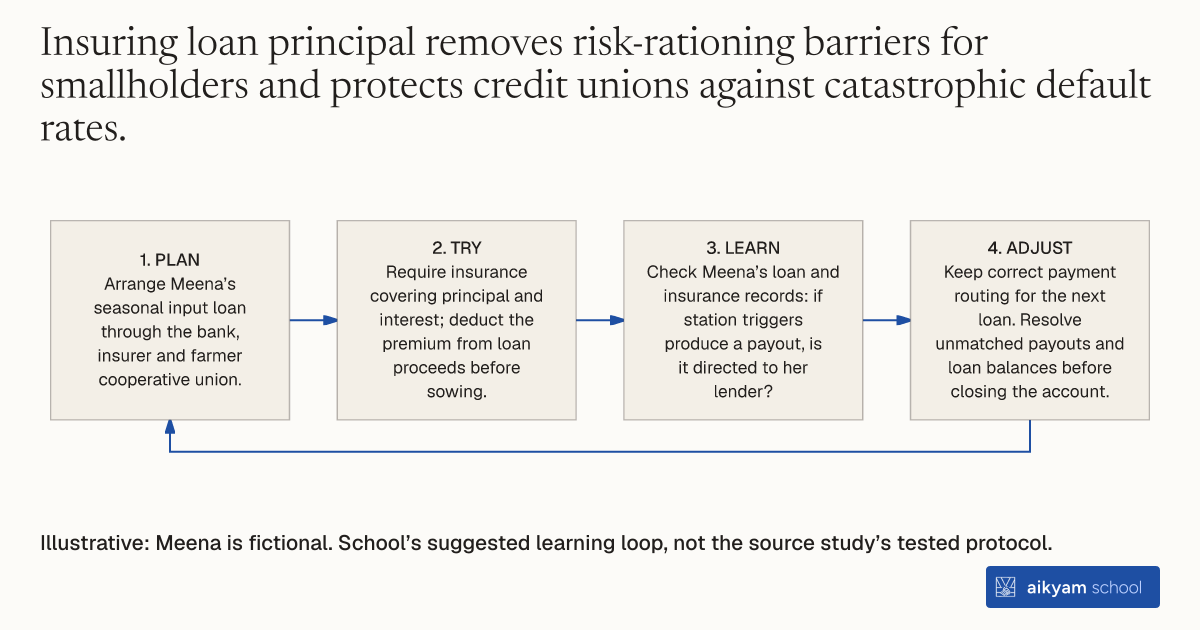
- Plan: Arrange Meena’s seasonal input loan through the bank, insurer and farmer cooperative union.
- Try: Require insurance covering principal and interest; deduct the premium from loan proceeds before sowing.
- Learn: Check Meena’s loan and insurance records: if station triggers produce a payout, is it directed to her lender?
- Adjust: Keep correct payment routing for the next loan. Resolve unmatched payouts and loan balances before closing the account.
Illustrative: Meena is fictional. School’s suggested learning loop, not the source study’s tested protocol.
See source →School’s suggested, untested loop. Observe loan funding, premiums and bank-directed payouts; this check does not establish farm investment effects.
How
When to use
Risk-averse smallholder farmers often refuse agricultural loans because drought shocks threaten loan default and asset loss. Commercial lenders also restrict uncollateralized credit to rural borrowers facing unmitigated weather hazards. Bundling weather index insurance directly into seasonal credit agreements protects both lenders and borrowers against drought defaults.
Bundle weather index insurance directly into seasonal agricultural credit contracts to cover loan repayment during drought shocks.
- Form a tripartite partnership between a commercial bank, an insurance firm, and a primary farmer cooperative union.
- Require borrowing farmers to purchase weather index insurance covering loan principal and interest as a condition for credit approval.
- Advance seasonal input loans directly to cooperative members through union credit facilities before the sowing season.
- Channel insurance premium payments automatically from loan proceeds to the participating insurer.
- Direct insurance payout funds to the lending bank to pay off farm loan balances automatically when local weather stations register deficit rainfall triggers.
- Forgive remaining farmer debt obligations upon receipt of indemnity payments following severe drought events.
Why it works
Directing payouts to the bank maintains rural financial stability without requiring manual debt collection during agricultural crises.
Example
Merkeb Cooperative Union and Dashen Bank offered interlinked credit-insurance loans in Feres Wega, Ethiopia, where 105 of 108 applicant farmers received average input loans of 1,675 Birr.
About the study
Participants
254 smallholder farmers (120 resurveyed in 2016) in Feres Wega kebele, Amhara Region, Ethiopia.
Study Design
Field pilot and retrospective survey evaluating an interlinked credit-insurance loan product administered through Merkeb Cooperative Union and Dashen Bank.
Results
Out of 120 surveyed farmers, 108 applied for interlinked credit, 105 received loan funding averaging 1,675 Birr, and 72 households reported increasing chemical fertilizer use compared to 9 reporting decreases.