In Simple Words
Imagine a bank offering to lend money to fruit vendors if a weather company promises to cover losses from rainstorms. However, the bank insists that local street market managers pay for any losses if vendors lose money for reasons other than rain. The market managers refuse to take on that burden, so no loans are ever handed out to the vendors.
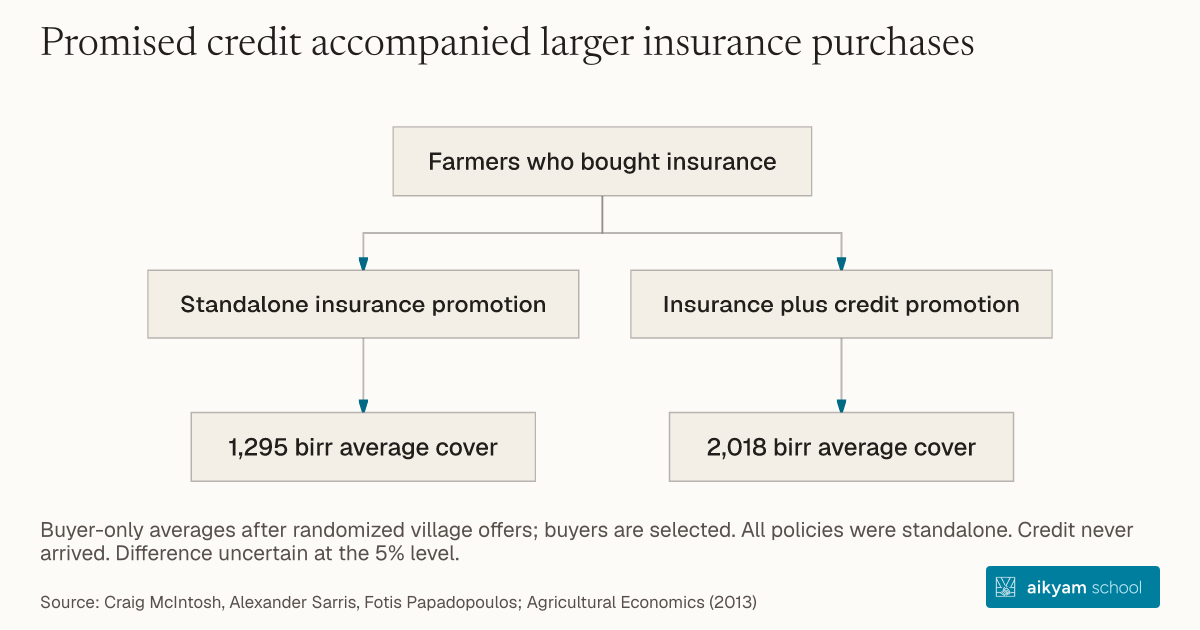
Farmers who bought insurance
- Standalone insurance promotion
- 1,295 birr average cover
- Insurance plus credit promotion
- 2,018 birr average cover
Buyer-only averages after randomized village offers; buyers are selected. All policies were standalone. Credit never arrived. Difference uncertain at the 5% level.
See source →Research question
Attempts to expand production credit by interlinking weather index insurance with bank loans fail when intermediary cooperatives refuse to assume non-weather borrower default risks. Although insurance covers weather-related default, lenders and cooperatives still face un-hedged default risk from non-weather shocks or moral hazard.
Participants
N = 460 rural smallholder households across 23 treatment cooperatives in Amhara, Ethiopia (17 interlinked treatment villages and 17 standalone treatment villages initially assigned).
Study Design
Field RCT testing interlinked loan-insurance contracts delivered via Dashen Bank, Nyala Insurance Company, and primary Cooperative Unions.
Results
Zero interlinked loan contracts were executed due to cooperative unions refusing to guarantee non-weather default risk. Consequently, 100% of realized insurance sales were standalone policies. However, in interlinked villages, farmers who bought insurance demanded higher coverage (mean sum insured = 2,018 Birr vs. 1,295 Birr in standalone villages, p < 0.10) expecting it would unlock future credit.
Takeaway
Structure interlinked agricultural credit contracts with clear institutional risk-sharing boundaries so intermediary cooperatives are not required to absorb non-weather default risk.
Source and citation
See source →Read alongside the research
Plain-English glossary
Original explanations, informed by the references below. Examples are illustrations, not data from the studies above. The research text stays unchanged.
- Randomized controlled trial
A study that uses chance, like drawing lots, to decide who receives each option being compared. Researchers compare the groups’ outcomes to estimate the effect of those options.
ExampleA lottery assigns volunteers to a training programme or a comparison group. Researchers then compare their outcomes.
GET-IT glossary · Randomized study ↗Read more about randomized controlled trial →