Research recruitment
Recruit through farmer networks
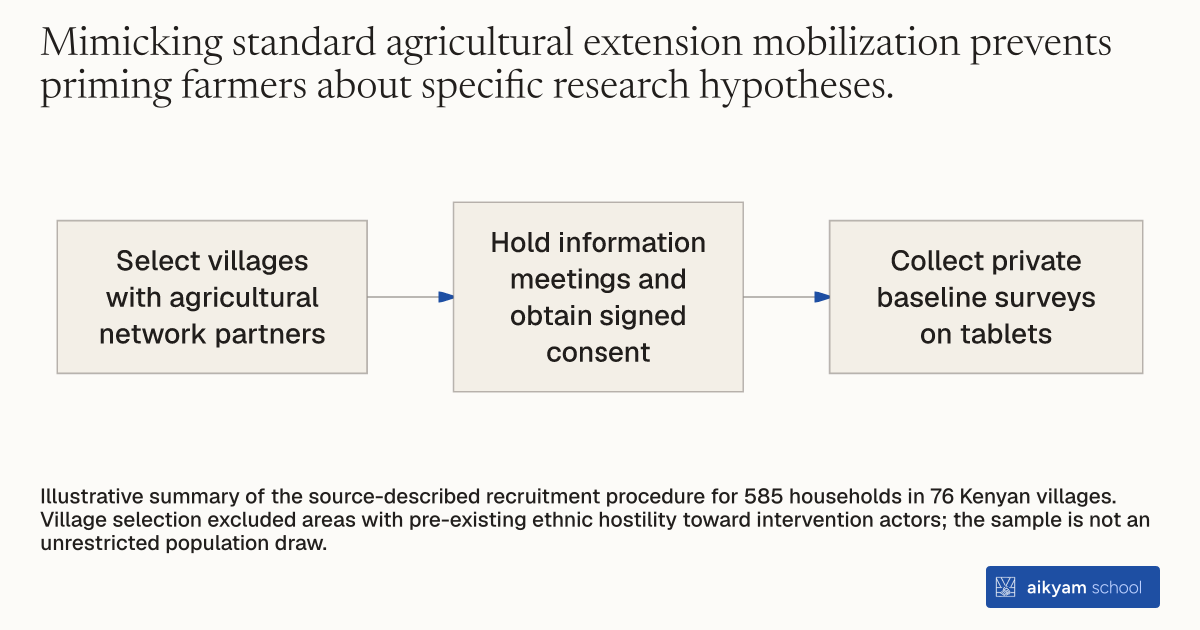
- Select villages with agricultural network partners
- Hold information meetings and obtain signed consent
- Collect private baseline surveys on tablets
Illustrative summary of the source-described recruitment procedure for 585 households in 76 Kenyan villages. Village selection excluded areas with pre-existing ethnic hostility toward intervention actors; the sample is not an unrestricted population draw.
See source →How
When to use
Recruiting rural smallholders for field studies often faces low trust, poor attendance, or logistical friction. Partnering with established grassroots agricultural research networks allows researchers to mobilize engaged community members without revealing experimental hypotheses. This method builds a representative trial sample across multiple rural sub-counties.
Recruit a representative trial sample of smallholders by leveraging established grassroots agricultural partner networks.
- Partner with a local agricultural extension organization operating active farmer research networks in target sub-counties.
- Select target villages near urban centers while excluding areas with pre-existing ethnic hostility toward proposed intervention actors.
- Conduct information meetings with village leaders and community members using standard extension programming protocols.
- Invite interested smallholders to central location sessions to explain study procedures and sign formal consent forms.
- Collect baseline survey data privately using local language enumerator teams on mobile tablet computers.
Why it works
Working through trusted local farmer networks provides a deep field structure that ensures high turnout and accurate household tracking across trial phases.
Example
Research teams partnered with Community Action for Rural Development in Migori County, Kenya to recruit roughly ten farmers per village. The recruitment drive yielded a final sample of 585 farming households across 76 villages in Suna East, Suna West, and Uriri sub-counties.
About the study
Participants
585 smallholding farmers across 76 villages in Suna East, Suna West, and Uriri sub-counties, Migori County, Kenya.
Study Design
Multi-stage sample selection via KALRO's Farmer Research Network, followed by baseline tablet surveying in private central locations.
Results
Network mobilization successfully recruited 585 eligible respondents across 76 villages, achieving balance across 29 baseline demographic and agricultural variables (with only 1 variable significant at the 10% level).