Research procedure
Score reported depressive symptoms
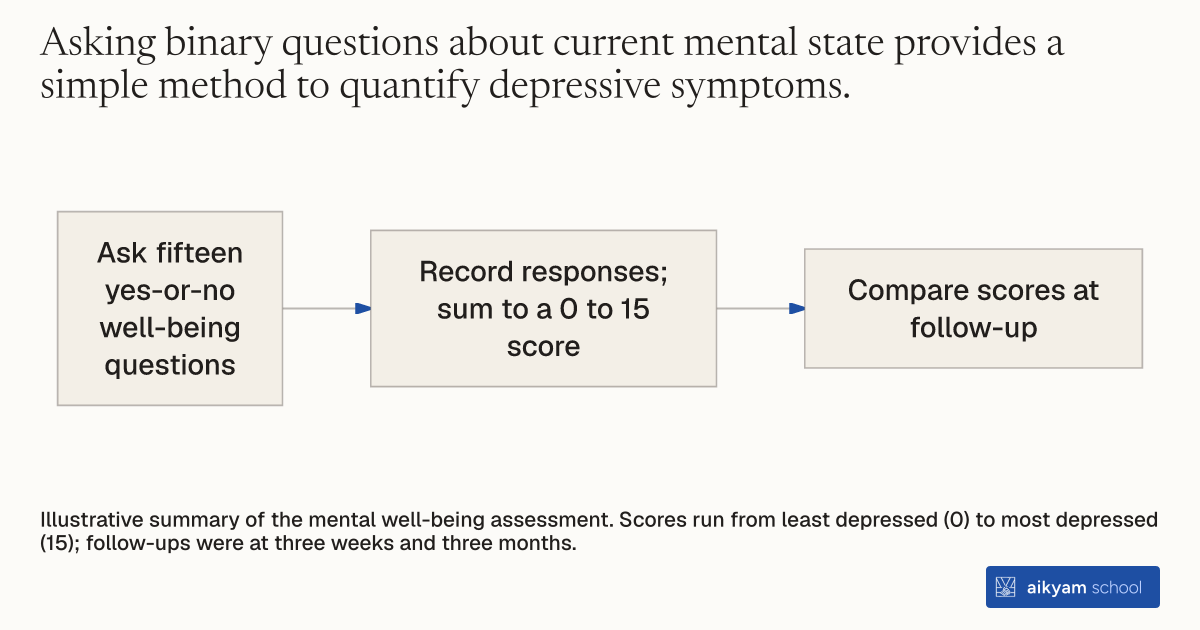
- Ask fifteen yes-or-no well-being questions
- Record responses; sum to a 0 to 15 score
- Compare scores at follow-up
Illustrative summary of the mental well-being assessment. Scores run from least depressed (0) to most depressed (15); follow-ups were at three weeks and three months.
See source →How
When to use
Older adults living alone face high risks of clinical depression and mental health decline. Program evaluators need a clear survey instrument to detect depressive symptoms among vulnerable seniors. Use this assessment tool to measure short-term and medium-term psychological outcomes.
Evaluate depression symptoms among older adults by scoring self-reported mental well-being across fifteen binary questions.
- Surveyors visit or call older adult participants at baseline and follow-up evaluation periods.
- Surveyors ask participants fifteen yes or no questions about their current mental well-being.
- Surveyors record a binary response for each mental health question.
- Surveyors sum positive responses into a total score ranging from 0 to 15 points.
- Surveyors categorize scores from 0 as least depressed to 15 as most depressed to track changes.
Why it works
Summing standardized responses into a numeric score allows evaluators to assess program impacts on mental well-being over time.
Example
Researchers in Tamil Nadu, India, evaluated depression among 1,120 older adults living alone using a 15-item questionnaire. Baseline results revealed that about one third of participants were moderately or severely depressed and over 20 percent were mildly depressed.
About the study
Participants
1,120 low-income adults aged 55 or older living alone in Tamil Nadu, India (83 percent women, 77.1 percent widowed).
Study Design
Randomized controlled trial collecting 15 yes-or-no mental well-being questions scored from 0 (least depressed) to 15 (most depressed) points at three weeks and three months follow-up across four study arms.
Results
Cash transfer recipients experienced a 1-point greater reduction in depression scores relative to comparison at three weeks, driven by women who saw a 1.4-point decrease, but no intervention improved depression at three months.