Try, learn and adjust
Check lay counsellor training covers the curriculum
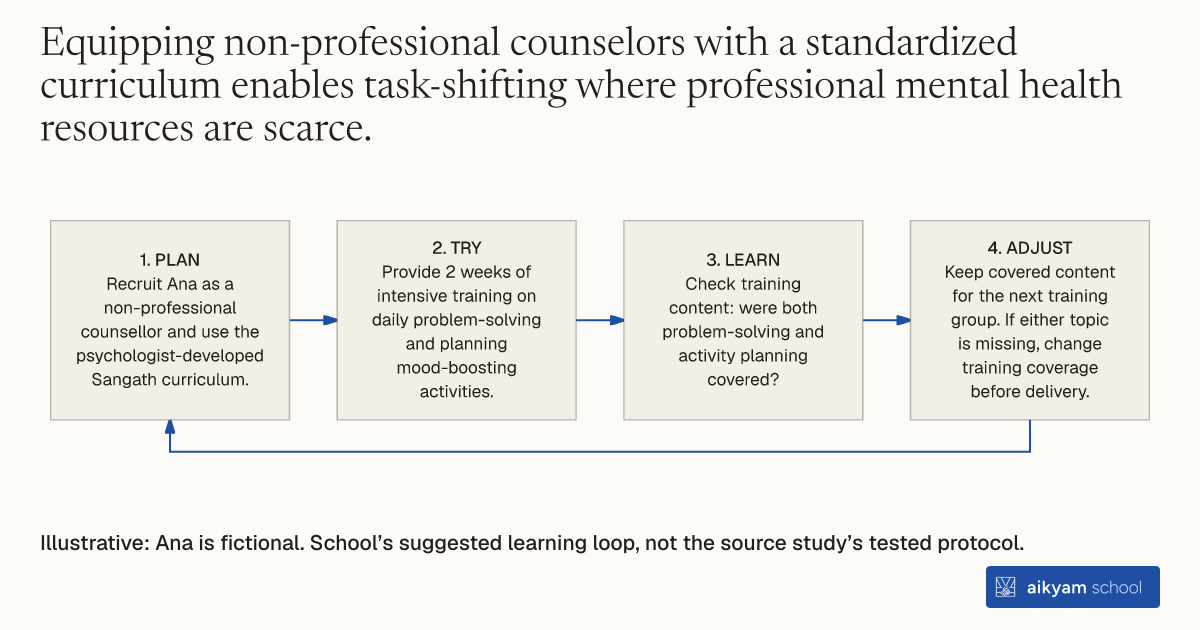
- Plan: Recruit Ana as a non-professional counsellor and use the psychologist-developed Sangath curriculum.
- Try: Provide 2 weeks of intensive training on daily problem-solving and planning mood-boosting activities.
- Learn: Check training content: were both problem-solving and activity planning covered?
- Adjust: Keep covered content for the next training group. If either topic is missing, change training coverage before delivery.
Illustrative: Ana is fictional. School’s suggested learning loop, not the source study’s tested protocol.
See source →School’s suggested learning loop: observe curriculum coverage. This training check does not establish counselling competence or clinical benefit.
How
When to use
Low- and middle-income countries frequently lack licensed therapists to treat depression among older adults. Training non-professional lay counselors in specialized talk therapy curricula expands local mental health workforce capacity. Use this approach to prepare lay personnel to deliver remote cognitive behavioral therapy.
Train non-professional lay counselors using a specialized cognitive behavioral therapy curriculum over two weeks.
- Program managers adopt a cognitive behavioral therapy curriculum developed by a psychologist at Sangath, a mental health nonprofit.
- Program managers recruit non-professional lay counselors to deliver remote mental health counseling.
- Instructors conduct intensive training for the lay counselors over two consecutive weeks.
- Instructors teach counselors to help participants brainstorm solutions to daily challenges.
- Instructors teach counselors to identify and plan mood-boosting activities with participants.
Why it works
Structured training prepares counselors to guide participants through problem-solving and mood-boosting activity planning.
Example
A psychologist at the mental health nonprofit Sangath developed a specialized cognitive behavioral therapy curriculum to train non-professional lay counselors over two weeks in Tamil Nadu, India. The trained counselors then delivered weekly 30- to 45-minute phone counseling calls to 377 older adults across six consecutive weeks.
About the study
Participants
1,120 low-income adults aged 55 or older living alone in Tamil Nadu, India, including 377 participants assigned to receive CBT from trained lay counselors.
Study Design
Randomized controlled trial evaluating lay counselors trained over two weeks in a specialized CBT curriculum to deliver six weekly phone sessions.
Results
Delivering phone CBT via trained lay counselors cost US\$19 per person and showed no statistically significant impact on functional impairment or depression scores at three-week or three-month follow-ups.