Research steps
Assess health before and after the programme
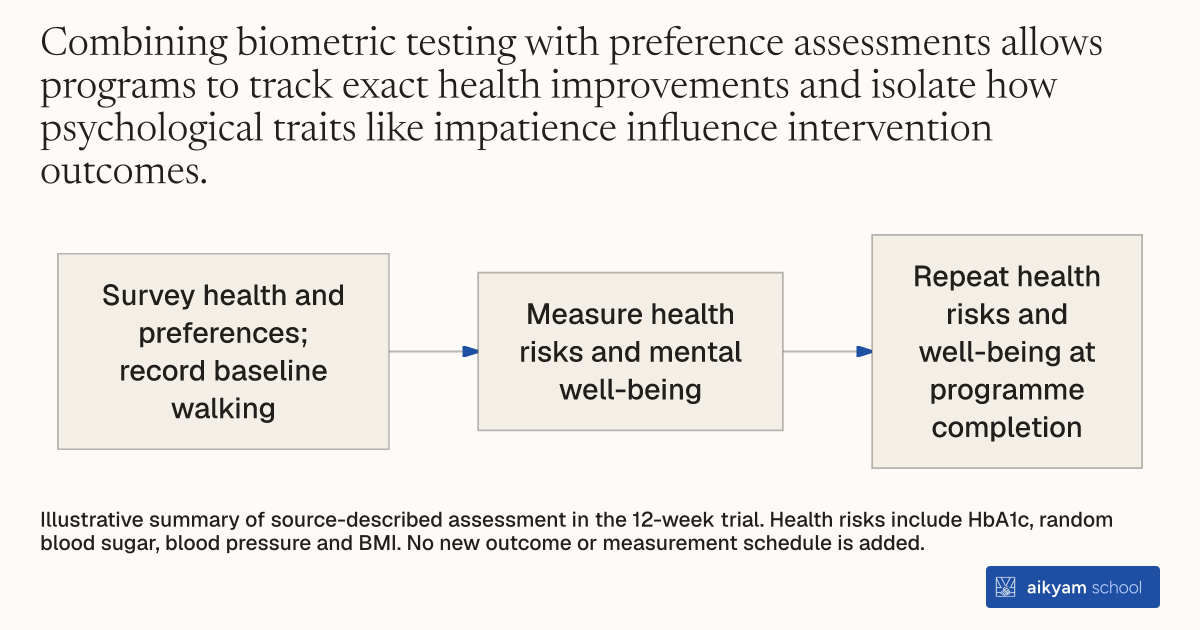
- Survey health and preferences; record baseline walking
- Measure health risks and mental well-being
- Repeat health risks and well-being at programme completion
Illustrative summary of source-described assessment in the 12-week trial. Health risks include HbA1c, random blood sugar, blood pressure and BMI. No new outcome or measurement schedule is added.
See source →How
When to use
Urban health initiatives need to evaluate the physical and psychological effects of behavior change programs on chronic disease outcomes. Collecting comprehensive baseline and endline indicators measures changes in health risk factors and psychological traits over time. This method serves health programs tracking diabetes, hypertension, and mental well-being in urban populations.
Assess physical health indicators and psychological impatience through structured surveys and clinical biometrics before and after behavioral interventions.
- Administer a baseline survey to collect participant demographic data and baseline health status.
- Measure baseline walking activity using tracking devices prior to starting intervention contracts.
- Assess participants' impatience levels using a series of preference survey questions.
- Measure health risk factors including HbA1c blood sugar levels, blood pressure, body mass index, and random blood sugar.
- Survey participants' mental health and overall well-being.
- Repeat health risk factor and mental well-being measurements at program completion to evaluate impact.
Why it works
Multi-dimensional evaluation captures both physical disease risk reductions and broader mental well-being benefits.
Example
In Tamil Nadu, India, researchers evaluated nearly 3,200 urban diabetics and pre-diabetics using baseline health surveys, preference questions, and physical measurements. Post-intervention assessments showed a 0.05 standard deviation reduction across an index of five health risk factors and significant improvements in mental health.
About the study
Participants
3,192 urban diabetics and pre-diabetics in Tamil Nadu, India; average age almost 50 years; 58 percent male.
Study Design
Baseline survey, preference assessment, and health risk factor measurement in a 12-week randomized controlled trial.
Results
Interventions led to a 0.05 standard deviation reduction across five health risk factors (including blood sugar, blood pressure, and BMI) and overall increases in the mental health index.