Research procedure
Present legal rights before hiring choices
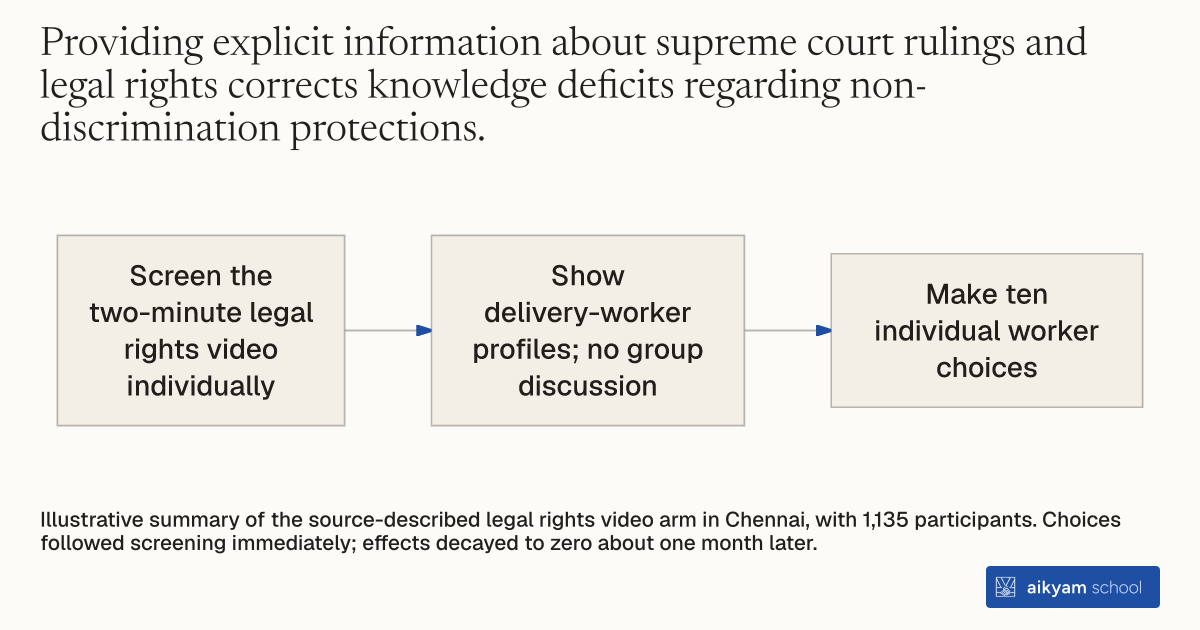
- Screen the two-minute legal rights video individually
- Show delivery-worker profiles; no group discussion
- Make ten individual worker choices
Illustrative summary of the source-described legal rights video arm in Chennai, with 1,135 participants. Choices followed screening immediately; effects decayed to zero about one month later.
See source →How
When to use
Many decision makers lack awareness of formal legal rights protecting transgender workers against workplace discrimination. Organizations often deploy brief educational media campaigns to inform managers and reduce hiring bias. This method provides a direct way for public agencies and employers to raise immediate awareness about relevant legal protections.
Screen a concise educational video detailing legal protections and constitutional rights for transgender workers to decision makers prior to candidate selection.
- Assemble hiring decision makers in individual screening sessions.
- Present a two-minute video featuring information on supreme court judgments and constitutional rights protecting transgender individuals.
- Ensure each participant watches the video completely without group discussion.
- Provide candidate profiles featuring cisgender and transgender workers for a delivery role immediately following the video.
- Have participants complete individual worker selection decisions.
Why it works
This information creates an immediate increase in compliance and supportive hiring behavior.
Example
In urban Chennai, India, 1,135 non-transgender individuals watched a two-minute video explaining supreme court rulings on transgender rights before choosing grocery delivery workers. The video screening increased transgender worker selection by 10.3 percentage points immediately after exposure.
About the study
Participants
3,397 non-transgender urban residents in Chennai, India, with 1,135 individuals assigned to the legal rights video screening arm.
Study Design
Randomized controlled trial framed as grocery delivery market research where participants viewed a two-minute video explaining legal rights before making ten binary hiring choices, with a follow-up persistence survey 2–9 weeks later.
Results
Viewing the legal rights video increased transgender worker selection by 10.3 percentage points (a 23 percent increase) immediately post-treatment, but behavioral impacts decayed completely to zero approximately one month later.