Research procedure
Announce later disclosure without discussion
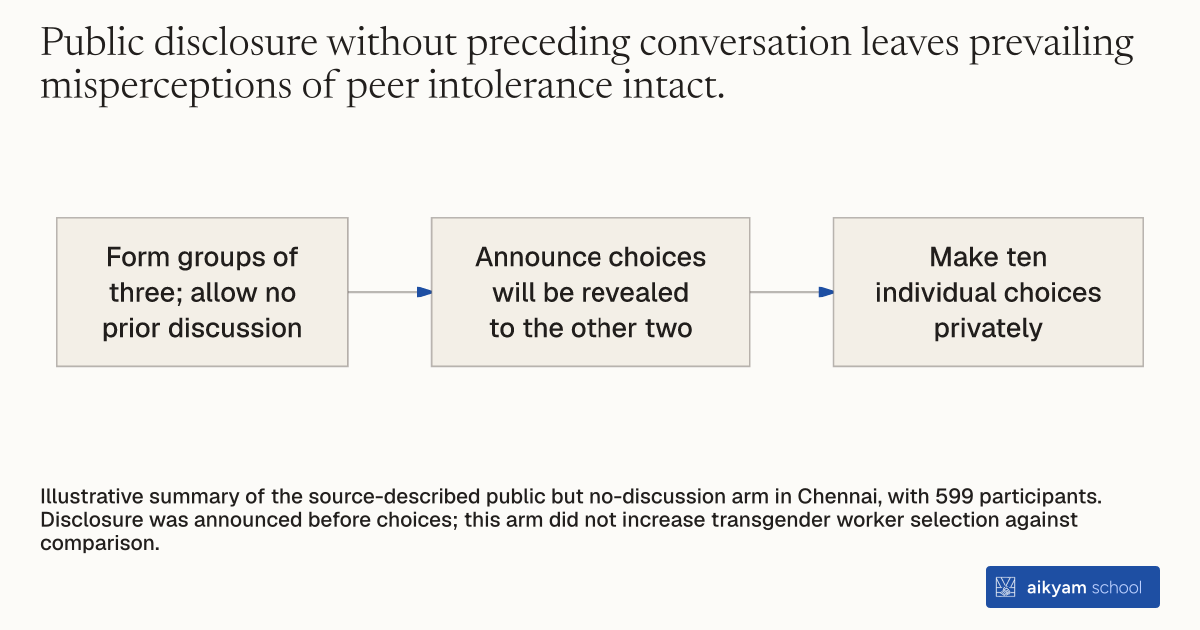
- Form groups of three; allow no prior discussion
- Announce choices will be revealed to the other two
- Make ten individual choices privately
Illustrative summary of the source-described public but no-discussion arm in Chennai, with 599 participants. Disclosure was announced before choices; this arm did not increase transgender worker selection against comparison.
See source →How
When to use
Organizations often make individual decisions observable to peers hoping public transparency alone will curb discrimination against marginalized workers. When decision makers assume their peers hold discriminatory attitudes, simply revealing choices without conversation fails to change behavior. This method benchmarks social observability alone against deliberative peer discussion for employers and evaluators.
Require individual decision makers to make candidate selections with the explicit understanding that their choices will later be disclosed to a group.
- Form groups of three non-transgender participants in a structured setting.
- Inform each member that they will make worker choices individually without any prior group discussion.
- Present candidate profiles featuring cisgender and transgender delivery workers.
- Notify participants before decision making that their specific candidate choices will be revealed to the other two group members afterward.
- Have each participant complete ten individual choices privately under known public disclosure.
Why it works
Without verbal exchange to reveal true pro-social norms, decision makers anticipate group stigma and conform to perceived discriminatory standards.
Example
In urban Chennai, India, 599 non-transgender individuals were assigned to make hiring choices for grocery delivery workers knowing their choices would later be revealed to two group peers. Making choices public without prior discussion produced zero increase in transgender worker selection compared to the private comparison group.
About the study
Participants
3,397 non-transgender urban residents in Chennai, India, with 599 individuals in the public but no discussion arm.
Study Design
Randomized controlled trial framed as grocery delivery market research where participants made ten binary hiring choices with known subsequent disclosure to peers but no prior verbal communication.
Results
Participants in the public but no-discussion arm (group three) were not more likely than the comparison group to hire transgender individuals.