Research steps
Compare direct and indirect answers
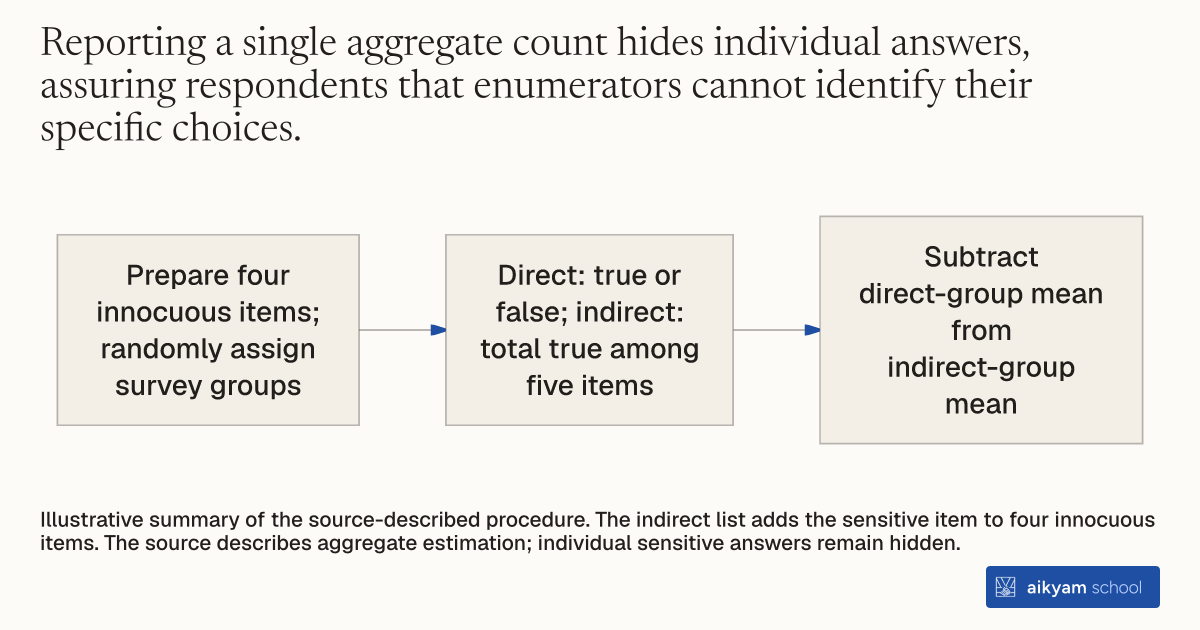
- Prepare four innocuous items; randomly assign survey groups
- Direct: true or false; indirect: total true among five items
- Subtract direct-group mean from indirect-group mean
Illustrative summary of the source-described procedure. The indirect list adds the sensitive item to four innocuous items. The source describes aggregate estimation; individual sensitive answers remain hidden.
See source →How
When to use
Survey respondents frequently give biased answers to questions about sensitive or socially uncomfortable behaviors. Direct questions about sexual practices, infidelity, or condom use often yield inaccurate self-reports due to social desirability bias. This method uses list randomization to elicit truthful aggregate estimates of sensitive behaviors while protecting respondent privacy.
Elicit truthful answers regarding sensitive personal behaviors by randomly assigning respondents to direct or indirect item lists during household surveys.
- Survey designers create four innocuous true-or-false statements unrelated to the sensitive topic.
- Evaluators randomly assign each survey respondent to either a direct elicitation or an indirect elicitation group.
- Enumerators ask direct group respondents whether the sensitive statement is true or false alongside the innocuous statements.
- Enumerators present indirect group respondents with five statements containing the four innocuous items plus the sensitive item.
- Enumerators record the total number of true statements reported by indirect respondents without identifying which specific statements are true.
- Researchers calculate the sample mean count of true statements for both groups and subtract the direct group mean from the indirect group mean to estimate the unbiased population percentage.
Why it works
Removing social desirability bias and fear of judgment leads to more accurate population estimates of sensitive behaviors.
Example
Jamison, Karlan, and Raffler used list randomization across 2,424 survey respondents in central Uganda to measure sexual behavior, revealing that infidelity rates were 27% in treatment villages compared to 12% in control villages.
About the study
Participants
2,424 adults aged 18 to 35 with at least six years of primary education in 60 villages across Masaka, Mpigi, Mityana, and Mubende districts in central Uganda.
Study Design
Clustered encouragement-design RCT utilizing list randomization to compare direct true/false responses against indirect statement count responses for sensitive sexual behaviors.
Results
List randomization revealed that unfaithfulness in the past 3 months increased from 12% in control to 27% in treatment (p = 0.02), and average sexual partner count in the past 3 months increased from 0.62 in control to 0.85 in treatment (p = 0.04).