Research design
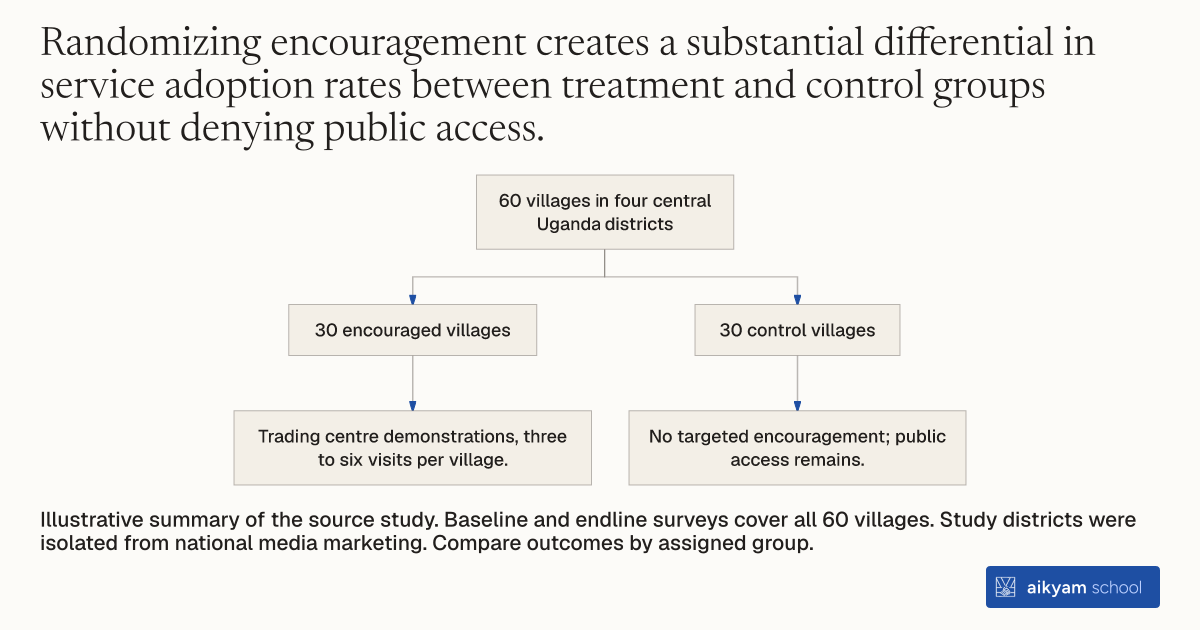
Randomise village encouragement
60 villages in four central Uganda districts
- 30 encouraged villages
- Trading centre demonstrations, three to six visits per village.
- 30 control villages
- No targeted encouragement; public access remains.
Illustrative summary of the source study. Baseline and endline surveys cover all 60 villages. Study districts were isolated from national media marketing. Compare outcomes by assigned group.
See source →How
When to use
Evaluating universal or public access interventions where enforcing strict treatment and control compliance is infeasible. Universal public availability or media exposure makes direct individual-level assignment impractical. This method uses targeted encouragement campaigns at the cluster level to evaluate program impacts rigorously without withholding access.
Evaluate program impact in open-access settings by randomly assigning clusters to receive localized promotion while withholding encouragement from control clusters.
- Evaluators select and map 60 distinct village clusters across four target evaluation districts in central Uganda.
- Researchers randomly assign 30 villages to receive high-intensity promotional encouragement and 30 villages to serve as control clusters.
- Marketing teams execute targeted village trading center demonstrations three to six times per treatment village to drive differential uptake.
- Field managers isolate study districts from national media marketing campaigns to prevent encouragement spillover into control villages.
- Survey enumerators conduct baseline and endline household surveys across all 60 villages to collect outcome data.
- Analysts compare outcomes between treatment and control clusters using ordinary least squares intention-to-treat regressions.
Why it works
Comparing outcome changes across clusters provides unbiased estimates of impact among individuals whose service usage was induced by the promotion.
Example
Jamison, Karlan, and Raffler evaluated the 6001 mHealth service across 60 villages in central Uganda by encouraging 30 treatment villages with trading center marketing, achieving 40% usage in treatment villages compared to 7% in control villages.
About the study
Participants
2,424 adults aged 18 to 35 with at least six years of primary education in 60 villages across Masaka, Mpigi, Mityana, and Mubende districts in central Uganda.
Study Design
Clustered encouragement-design randomized evaluation in 60 villages with baseline and follow-up individual surveys, community surveys, and qualitative focus groups.
Results
Encouragement increased service awareness from 24% to 48% and service usage from 7% to 40%, but resulted in no significant change in composite HIV knowledge (-0.0575 SD) and an overall shift toward riskier behavior (-0.1128 SD).