Research steps
Report a private combined count
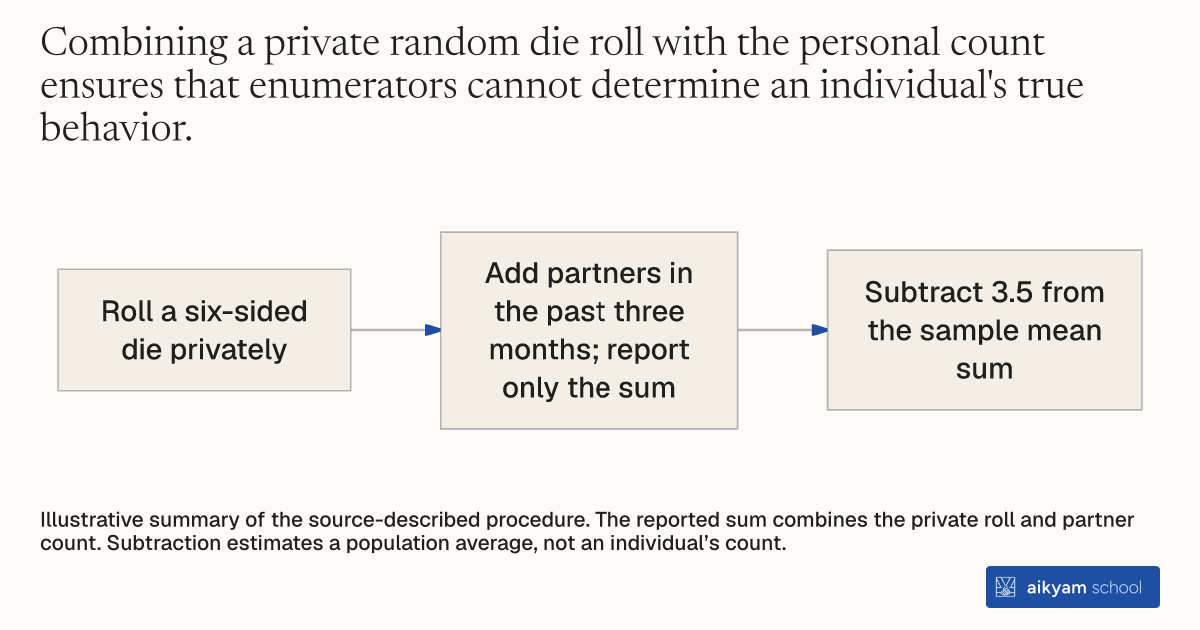
- Roll a six-sided die privately
- Add partners in the past three months; report only the sum
- Subtract 3.5 from the sample mean sum
Illustrative summary of the source-described procedure. The reported sum combines the private roll and partner count. Subtraction estimates a population average, not an individual’s count.
See source →How
When to use
Surveys collecting numerical data on sensitive personal behaviors often suffer from underreporting and social desirability bias. Direct questions about the total number of recent sexual partners create embarrassment or fear of judgment. This method uses die roll randomization to mask individual numerical answers while enabling researchers to calculate accurate population averages.
Elicit truthful counts of sensitive personal behaviors by adding a randomized die face value to the reported number.
- Survey enumerators assign eligible household respondents to the indirect elicitation group during field interviews.
- Enumerators provide each respondent with a standard six-sided playing die.
- Enumerators instruct the respondent to roll the die privately without showing the face value to the surveyor.
- Respondents add their actual number of sexual partners in the past three months to the face value rolled on the die.
- Respondents state only the combined sum to the enumerator.
- Researchers calculate the true population average count by subtracting 3.5, the expected mean of a fair die, from the sample mean sum.
Why it works
Complete privacy eliminates social desirability bias, encouraging respondents to report accurate numerical figures.
Example
Jamison, Karlan, and Raffler asked respondents in central Uganda to roll a playing die and report the sum of the die roll and their sexual partners in the past three months, revealing an average of 0.85 partners in treatment villages compared to 0.62 in control villages.
About the study
Participants
2,424 adults aged 18 to 35 with at least six years of primary education in 60 villages across Masaka, Mpigi, Mityana, and Mubende districts in central Uganda.
Study Design
Clustered encouragement-design RCT utilizing die roll randomization in follow-up household surveys to measure individual counts of sensitive sexual behaviors.
Results
Die roll randomization revealed that the average number of sexual partners in the past 3 months increased overall from 0.62 in control to 0.85 in treatment (p = 0.04), with male partners increasing from 0.63 to 1.04 (p = 0.02).