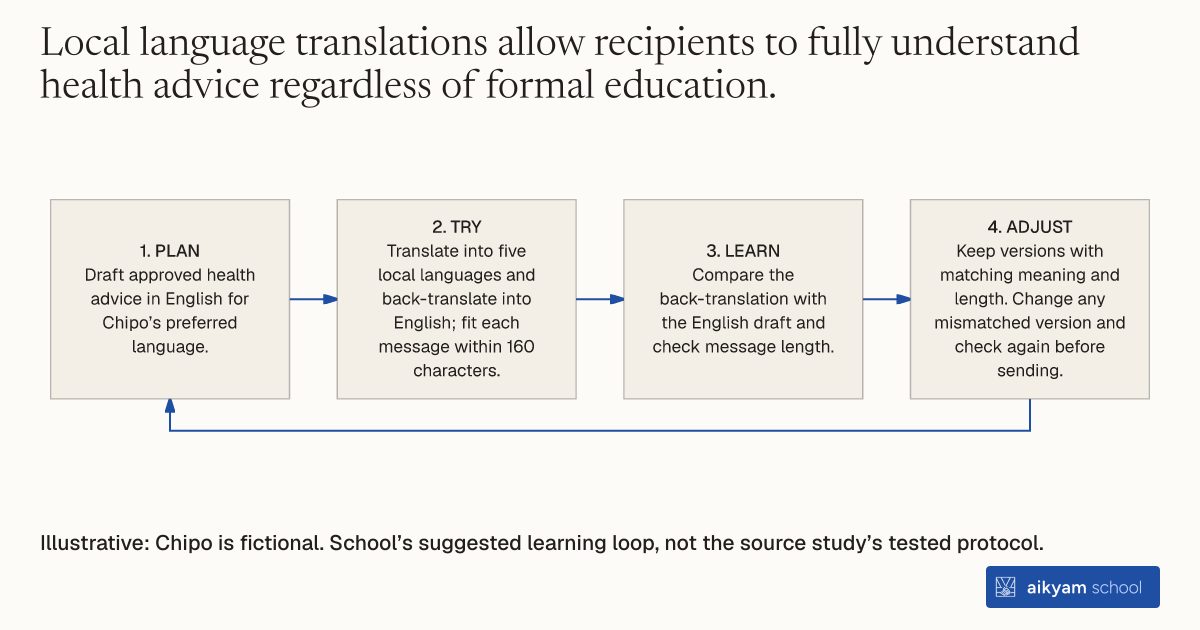
Try, learn and adjust
Check health message translation and length
- Plan: Draft approved health advice in English for Chipo’s preferred language.
- Try: Translate into five local languages and back-translate into English; fit each message within 160 characters.
- Learn: Compare the back-translation with the English draft and check message length.
- Adjust: Keep versions with matching meaning and length. Change any mismatched version and check again before sending.
Illustrative: Chipo is fictional. School’s suggested learning loop, not the source study’s tested protocol.
See source →School’s suggested learning loop, not the source’s tested procedure. Observe translation accuracy, preferred language and the 160-character limit. This is a preparation check, not an impact test.
How
When to use
Public health text campaigns must reach populations who speak diverse languages and use basic mobile phones. Technical jargon or long messages in foreign languages reduce comprehension and fail on basic devices. Translating health messages into local languages and restricting length ensures clarity across basic feature phones.
Translate and format official public health advice into short, local-language text messages for mobile transmission.
- Draft health advisories in English following approved national health guidelines.
- Translate draft messages into five local languages spoken across target regions.
- Back-translate local language versions into English to verify wording accuracy.
- Format all messages to fit strictly within a single SMS limit of 160 characters.
- Transmit messages matched to recipients' preferred languages to basic feature phones.
Why it works
Limiting text length to 160 characters ensures complete message delivery without truncation on basic feature phones.
Example
In Zambia, health messages covering handwashing, mask wearing, stigma reduction, social distancing, and vaccines were developed in English, translated and back-translated into five local languages, and formatted within 160 characters to reach 3,027 primary participants and 8,779 peer contacts.
About the study
Participants
3,027 primary participants and 8,779 peer contacts across Zambia, where 45.9% had secondary education and respondents resided across ten provinces.
Study Design
Public health text messages were translated and back-translated into five local languages and constrained to 160 characters to ensure readability on basic feature phones across four scheduled campaigns over 13 days.
Results
Transmitted local-language health messages achieved reported message receipt rates of up to 60% in survey round 3 (28% control baseline plus 32-35 percentage point increases in direct health authority arms).