Try, learn and adjust
Check local repair support reaches households
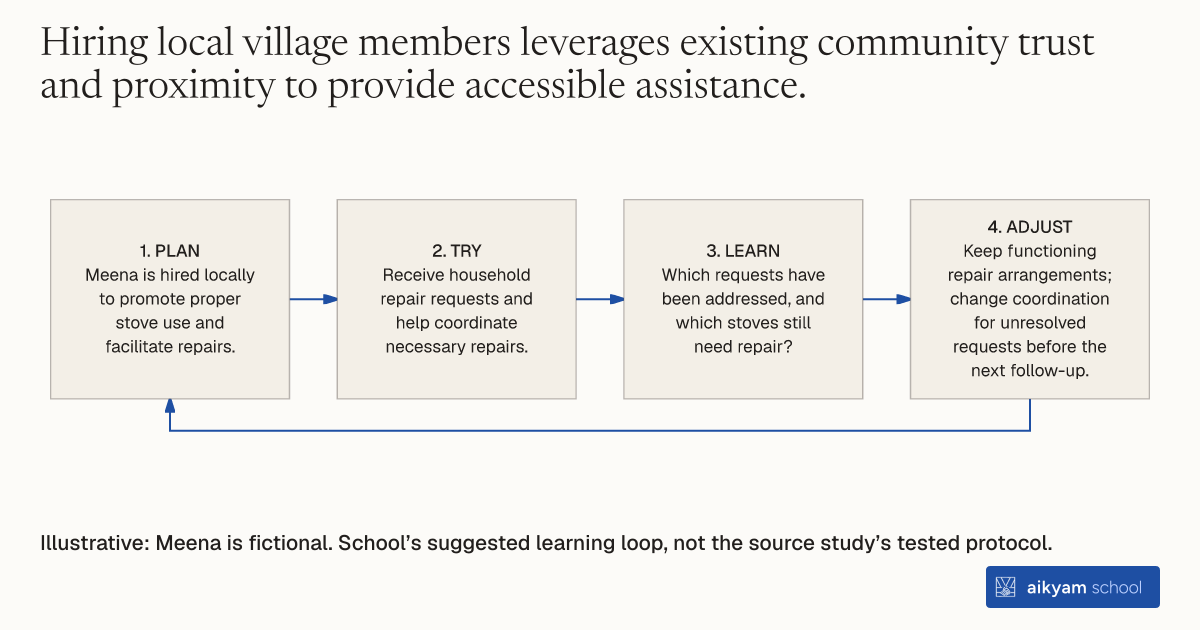
- Plan: Meena is hired locally to promote proper stove use and facilitate repairs.
- Try: Receive household repair requests and help coordinate necessary repairs.
- Learn: Which requests have been addressed, and which stoves still need repair?
- Adjust: Keep functioning repair arrangements; change coordination for unresolved requests before the next follow-up.
Illustrative: Meena is fictional. School’s suggested learning loop, not the source study’s tested protocol.
See source →School’s suggested learning loop, not a tested source procedure. Observe repair requests, stove condition and use; local support did not prevent declining stove use in the study.
How
When to use
Rural households adopting new cookstoves face ongoing maintenance difficulties and rapid stove deterioration. Without local support, households quickly abandon new cooking technology and return to traditional open stoves. Program managers recruit and hire local village residents to promote stove adoption and facilitate needed repairs.
Hire local village members to promote stove adoption and facilitate stove repairs across target communities.
- Program managers recruit respected community members within each participating village in Orissa, India.
- Program managers hire selected village members as local promoters and repair facilitators.
- Local promoters conduct village-level promotion activities to encourage households to use their improved cookstoves properly.
- Facilitators receive repair requests from participating households when stoves break or deteriorate.
- Facilitators assist households in coordinating and completing necessary stove repairs to maintain functionality over time.
Why it works
Local facilitators help overcome user hesitation and simplify the maintenance process when delicate mud stoves require repair.
Example
In Orissa, India, researchers and NGO Gram Vikas hired members of each participating village across 44 villages to support a cookstove program serving 2,575 households. Despite hiring local promoters and facilitators, improved stoves required substantially more repair than traditional stoves, and stove usage fell to 44 percent by year three.
About the study
Participants
2,575 households in 44 rural villages, Orissa, India.
Study Design
Four-year longitudinal Randomized Controlled Trial (RCT) evaluating cookstove adoption and maintenance support.
Results
Despite hiring local village promoters and repair facilitators, improved stoves required substantially more repair than traditional stoves, and stove usage dropped from 62 percent in years one and two to 44 percent in year three.