Try, learn and adjust
Use peer reports to identify stove repairs
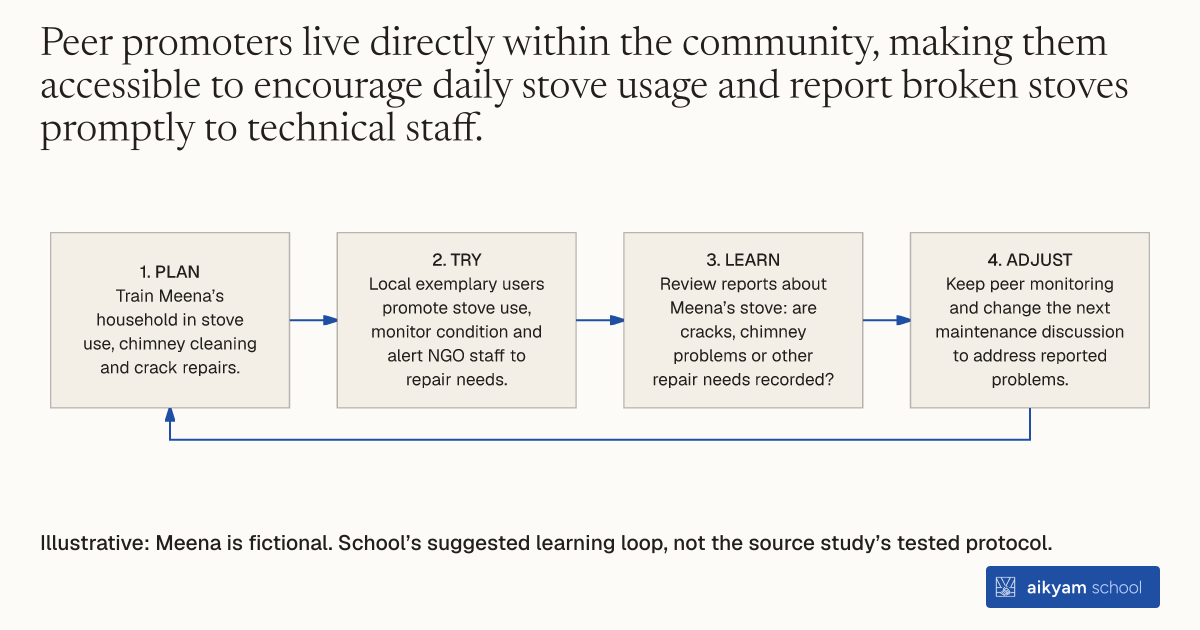
- Plan: Train Meena’s household in stove use, chimney cleaning and crack repairs.
- Try: Local exemplary users promote stove use, monitor condition and alert NGO staff to repair needs.
- Learn: Review reports about Meena’s stove: are cracks, chimney problems or other repair needs recorded?
- Adjust: Keep peer monitoring and change the next maintenance discussion to address reported problems.
Illustrative: Meena is fictional. School’s suggested learning loop, not the source study’s tested protocol.
See source →School’s suggested, untested loop. Observe condition and repair reports; the source records increasing disrepair despite training and promoters.
How
When to use
Rural households using newly installed improved cookstoves often lack knowledge on correct stove operation and maintenance. This knowledge gap leads to clogged chimneys, broken stoves, and technology abandonment. Program managers can hire local peer promoters to train neighbors and monitor stove condition.
Establish a community peer network to deliver stove maintenance training and report repair needs to program managers.
- Conduct training sessions for household members on proper stove operation, chimney cleaning, and crack repairs.
- Select exemplary stove users within each village to act as local peer promoters.
- Deploy peer promoters to encourage ongoing stove usage among neighboring households.
- Instruct peer promoters to monitor community stoves and alert NGO staff whenever a stove needs repair.
Example
Gram Vikas hired exemplary stove users across 44 villages in Orissa to promote stove usage and notify NGO staff when stoves fell into disrepair.
About the study
Participants
2,651 participating households across 44 villages in Orissa, India.
Study Design
Four-year randomized controlled trial evaluating an NGO program across three phased wave cohorts.
Results
Despite user training and peer promoters, stove disrepair increased over time, reducing clean stove ownership relative to comparison households from 65 percentage points in years one and two to 44 percentage points in year three.