Try, learn and adjust
Check stove use and maintenance support
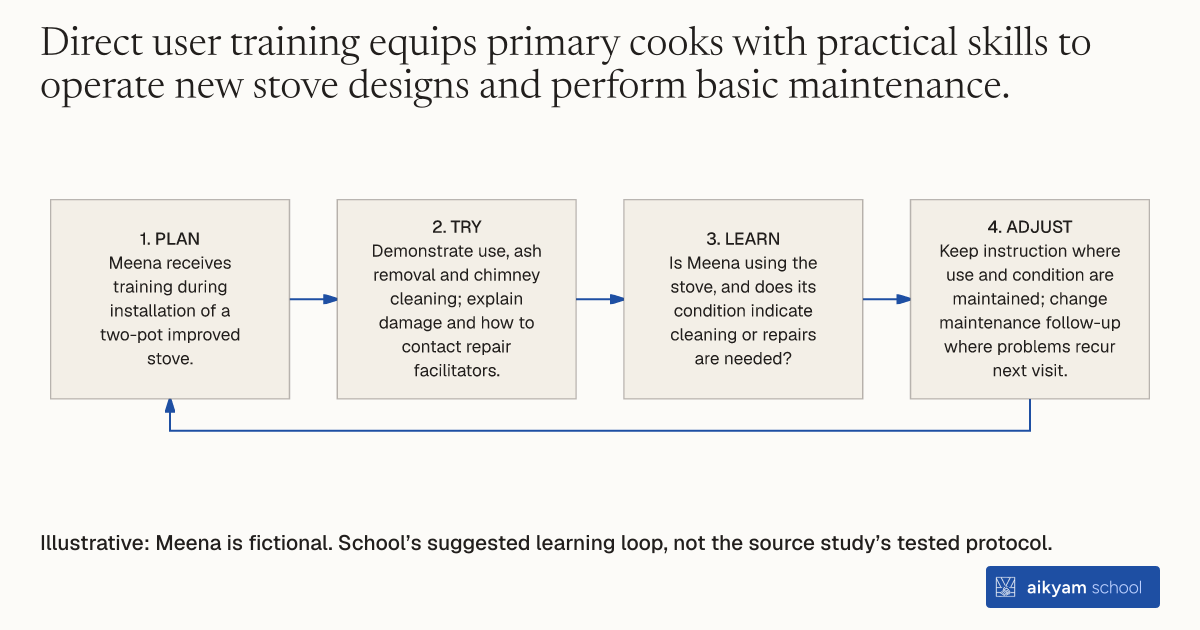
- Plan: Meena receives training during installation of a two-pot improved stove.
- Try: Demonstrate use, ash removal and chimney cleaning; explain damage and how to contact repair facilitators.
- Learn: Is Meena using the stove, and does its condition indicate cleaning or repairs are needed?
- Adjust: Keep instruction where use and condition are maintained; change maintenance follow-up where problems recur next visit.
Illustrative: Meena is fictional. School’s suggested learning loop, not the source study’s tested protocol.
See source →School’s suggested learning loop, not a tested source procedure. Observe stove use, condition and repair needs; training did not prevent declining use in the study.
How
When to use
Rural households adopting improved cookstoves often lack experience in operating multi-pot ventilated units. Incorrect operation and neglect of routine care cause rapid soot buildup, structural damage, and eventual abandonment. Program instructors deliver targeted training sessions to recipient households to teach proper stove operation and routine maintenance.
Deliver targeted instruction to households on operating and maintaining improved cookstoves.
- Program instructors visit recipient households during stove installation in participating villages.
- Instructors deliver training sessions explaining proper two-pot stove operation to primary cooks.
- Instructors demonstrate routine maintenance procedures including ash removal and chimney cleaning.
- Instructors guide household members on identifying structural damage requiring technical repair.
- Instructors direct households to contact village repair facilitators when major repairs are needed.
Why it works
Teaching proper chimney care prevents blockages that disrupt smoke ventilation.
Example
In Orissa, India, program staff provided training sessions on proper stove use and maintenance to 2,575 households across 44 villages. Despite training, households experienced significant maintenance challenges, and weekly meals cooked on good-condition stoves fell from 3.5 to 1.8 by year three.
About the study
Participants
2,575 households in 44 rural villages, Orissa, India.
Study Design
Four-year longitudinal Randomized Controlled Trial (RCT) evaluating cookstove training, maintenance, and usage across staggered construction waves.
Results
Despite user training sessions, improved stoves required substantially more repair than traditional stoves, and weekly meals prepared on good-condition stoves fell from 3.5 to 1.8 by year three.