Research procedure
Track health across four years
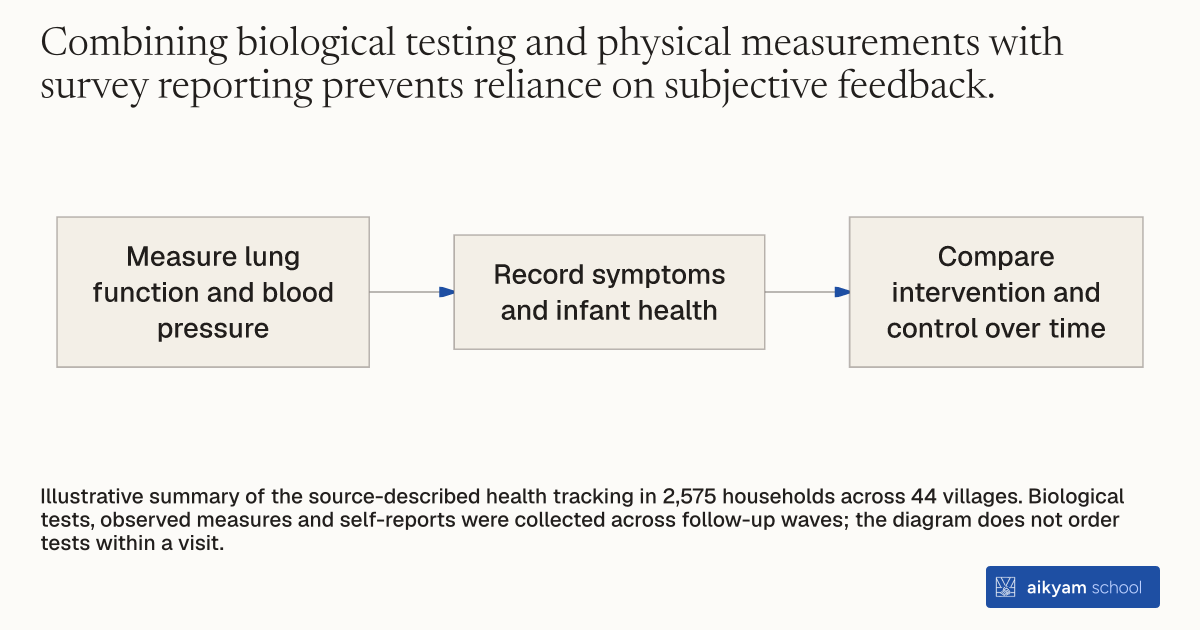
- Measure lung function and blood pressure
- Record symptoms and infant health
- Compare intervention and control over time
Illustrative summary of the source-described health tracking in 2,575 households across 44 villages. Biological tests, observed measures and self-reports were collected across follow-up waves; the diagram does not order tests within a visit.
See source →How
When to use
Public health programs targeting indoor air pollution assume that reducing smoke exposure will improve health. Evaluators cannot rely solely on self-reported health symptoms, which suffer from perception bias. Field evaluators use longitudinal health tracking that combines biological testing, clinical observations, and survey reporting to measure health impacts.
Track human health metrics across multi-year follow-ups using biological testing, physical observations, and health surveys.
- Field health workers visit sampled households across target villages during evaluation waves over four years.
- Health workers conduct respiratory tests measuring lung functioning among household members using spirometry.
- Health workers administer clinical health batteries to measure observed physical health indicators including blood pressure.
- Health workers record observed and self-reported respiratory symptoms including coughs and colds for primary cooks and children.
- Health workers collect health measurements for infants born into participating households during the study period.
- Evaluators compare health indicators between intervention and control households across follow-up waves.
Why it works
Following households for four years reveals whether early exposure reductions lead to lasting health gains.
Example
Researchers tracked 2,575 households across 44 villages in Orissa, India over four years following cookstove distribution. Biological tests of lung functioning, blood pressure measurements, cough and cold observations, and infant health tracking confirmed that stove offers yielded zero long-run health improvement.
About the study
Participants
2,575 households in 44 rural villages, Orissa, India.
Study Design
Four-year longitudinal Randomized Controlled Trial (RCT) tracking lung function, blood pressure, coughs, colds, and infant health outcomes across lottery phase-in waves.
Results
Respiratory tests of lung functioning and observed and self-reported health measures (blood pressure, cough, cold, infant health) confirmed that being offered a stove had no impact on health outcomes.