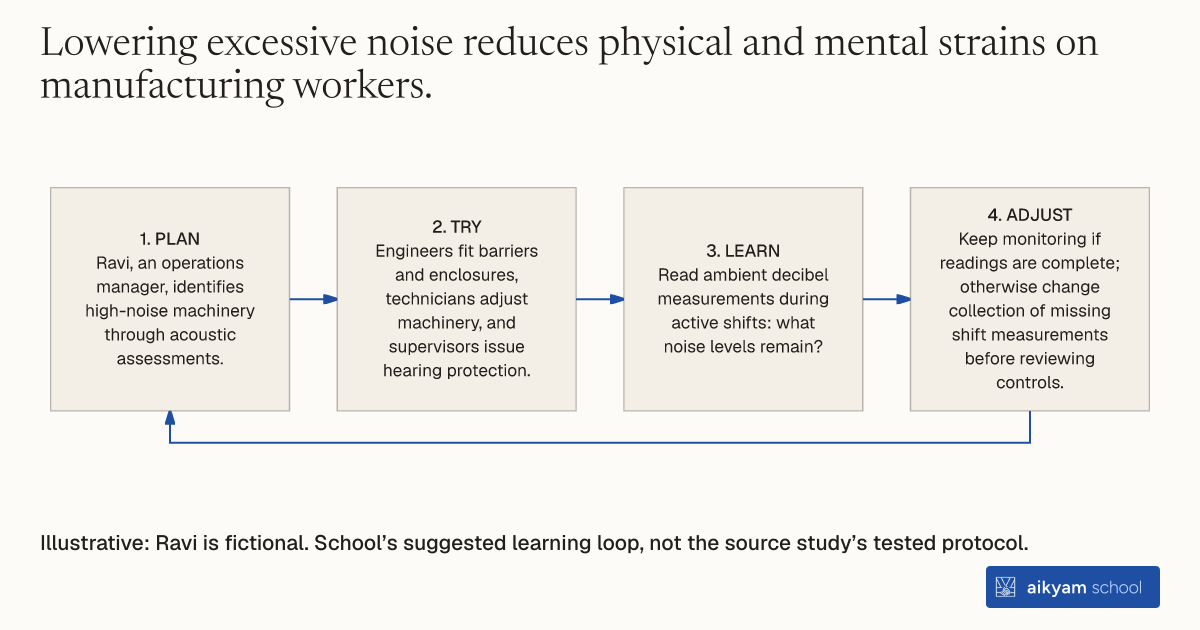
Try, learn and adjust
Check machinery noise controls and measurements
- Plan: Ravi, an operations manager, identifies high-noise machinery through acoustic assessments.
- Try: Engineers fit barriers and enclosures, technicians adjust machinery, and supervisors issue hearing protection.
- Learn: Read ambient decibel measurements during active shifts: what noise levels remain?
- Adjust: Keep monitoring if readings are complete; otherwise change collection of missing shift measurements before reviewing controls.
Illustrative: Ravi is fictional. School’s suggested learning loop, not the source study’s tested protocol.
See source →School’s suggested, untested learning loop. Observe machinery noise and control delivery; this suggested loop is not a complete occupational safety protocol.
How
When to use
In manufacturing plants, loud machinery exposes workers to excessive acoustic noise. Chronic workplace noise impairs cognitive function and increases physical strain on assembly staff. Installing noise reduction equipment and acoustic dampening lowers shop floor noise and boosts worker output.
Install acoustic dampening controls and lower noise emissions from heavy manufacturing equipment to reduce workplace cognitive strain.
- Plant operations managers conduct acoustic assessments to identify high-noise machinery on the shop floor.
- Facilities engineers fit noise-dampening enclosures and acoustic barriers around loud equipment.
- Maintenance technicians calibrate machinery components to minimize operational vibration and sound output.
- Supervisors issue personal hearing protection equipment to workers stationed near heavy machinery.
- Production managers monitor indoor ambient decibel levels across assembly lines during active shifts.
Why it works
Reducing cognitive interference from loud equipment allows staff to maintain focus and work more efficiently.
Example
A study evaluating strategies to reduce physical strains tested lowering excessive noise from manufacturing equipment, demonstrating that mitigating workplace noise improved cognitive function and boosted worker productivity.
About the study
Participants
Manufacturing line workers exposed to high machinery noise.
Study Design
Randomized evaluation measuring the impact of workplace noise mitigation on worker cognitive function and productivity.
Results
Reducing excessive machinery noise mitigated physical and mental strain on manufacturing employees, resulting in increased worker productivity.