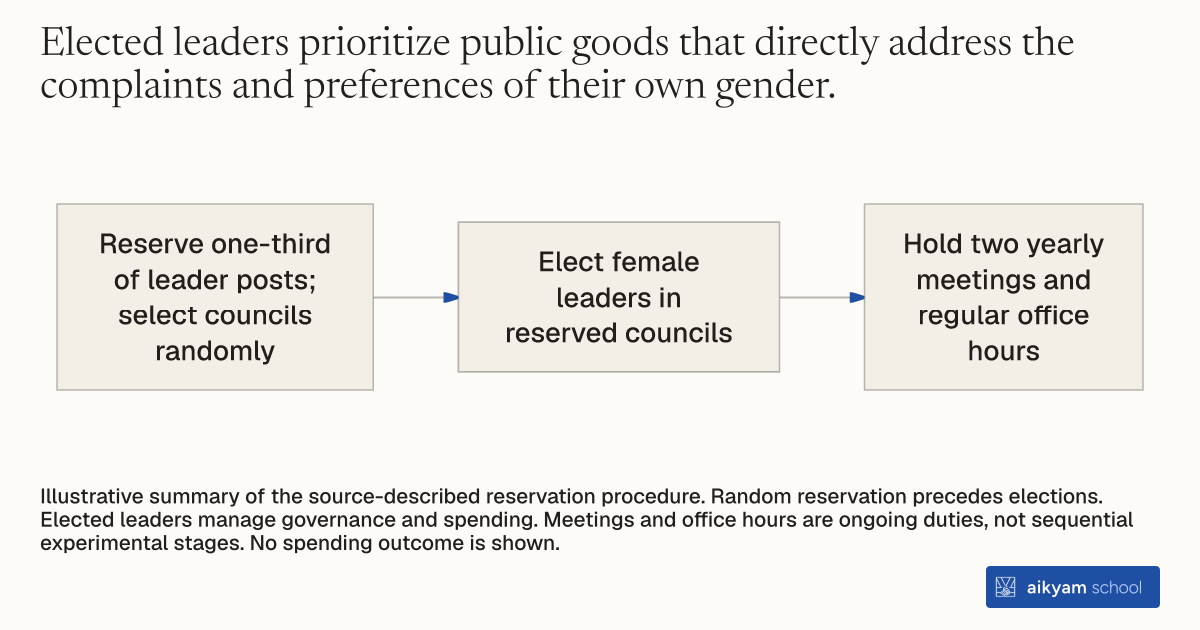
Research procedure
Reserve council leadership seats for women
- Reserve one-third of leader posts; select councils randomly
- Elect female leaders in reserved councils
- Hold two yearly meetings and regular office hours
Illustrative summary of the source-described reservation procedure. Random reservation precedes elections. Elected leaders manage governance and spending. Meetings and office hours are ongoing duties, not sequential experimental stages. No spending outcome is shown.
See source →How
When to use
Women hold few political leadership positions worldwide. This underrepresentation causes local governments to overlook public services that female citizens need. Mandate reserved leadership seats for female candidates in rural village councils to align public spending with women's preferences.
Mandate a fixed proportion of village council leadership positions for female candidates through random reservation.
- Amend national or state electoral laws to reserve one-third of village council leader positions for female candidates.
- Select target village councils randomly in each administrative district to receive female leader reservations during election cycles.
- Elect a female full-time village council leader in each reserved council to manage governance and make final spending decisions.
- Require each elected leader to organize two annual village meetings for presenting proposed budgets and reporting on council activities.
- Establish regular leader office hours where rural citizens lodge formal complaints and requests regarding local public services.
Why it works
Female leaders direct public investment toward local infrastructure that female citizens request, such as clean drinking water.
Example
In Birbhum, West Bengal, female-led reserved councils invested in 9 more drinking water facilities and improved road conditions by 18 percent compared to male-led councils. In Udaipur, Rajasthan, female-led reserved councils invested in 2.62 more drinking water facilities and made fewer road improvements, reflecting female complaints where 54 percent requested drinking water facilities.
About the study
Participants
265 village councils across Birbhum in West Bengal and Udaipur in Rajasthan, India, serving rural civil servants and rural populations.
Study Design
Randomized controlled trial comparing randomly assigned female-reserved village councils to unreserved male-led village councils using leader interviews, local public goods audits in three randomly selected villages per council, meeting minutes, and six months of logged citizen complaints.
Results
In West Bengal, female-reserved councils invested in 9 more drinking water facilities and improved road conditions by 18 percent, matching women's complaints where 31 percent concerned water and 31 percent concerned roads. In Rajasthan, female-reserved councils invested in 2.62 more drinking water facilities and reduced road improvements by 8 percent, matching women's complaints where 54 percent concerned water and 13 percent concerned roads.