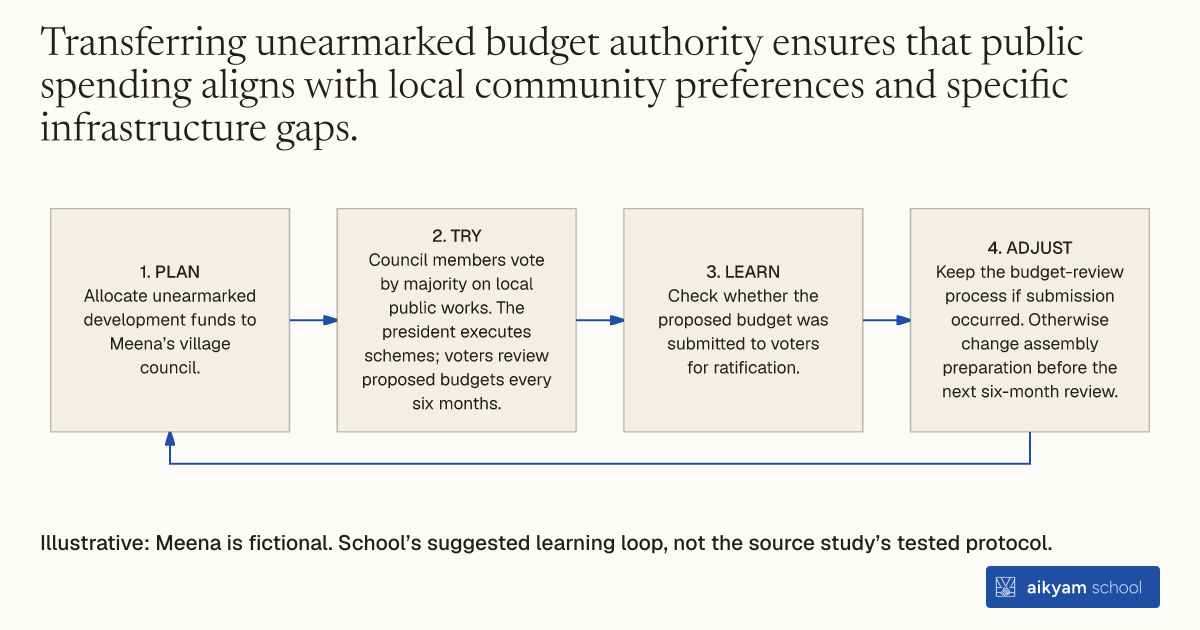
Try, learn and adjust
Check council budget decisions reach public review
- Plan: Allocate unearmarked development funds to Meena’s village council.
- Try: Council members vote by majority on local public works. The president executes schemes; voters review proposed budgets every six months.
- Learn: Check whether the proposed budget was submitted to voters for ratification.
- Adjust: Keep the budget-review process if submission occurred. Otherwise change assembly preparation before the next six-month review.
Illustrative: Meena is fictional. School’s suggested learning loop, not the source study’s tested protocol.
See source →School’s suggested learning loop: observe majority allocation decisions and budget submission; this check does not establish better service delivery.
How
When to use
Central and state governments struggle to deliver essential services and align public spending with local needs in diverse rural communities. Centralized funding earmarks fail to address specific local infrastructure deficits and community priorities. Devolving untied budget authority to grassroots village councils gives rural residents direct influence over local public expenditure.
Devolve spending authority for public works and welfare services from regional state governments to grassroots village councils.
- State governments allocate unearmarked development scheme funds directly to village councils rather than earmarking them for central projects.
- Village council members vote by majority to allocate funds across local public works such as drinking water, roads, housing, electricity, irrigation, and education.
- Village council presidents execute the chosen development schemes and oversee public works projects.
- Village councils host general assemblies every six months to submit proposed budgets to voters for ratification.
Example
Following the 1992 constitutional amendment in India, state governments devolved public works spending to Gram Panchayats serving 10,000 residents each across West Bengal and Rajasthan.
About the study
Participants
265 village councils (165 in West Bengal and 100 in Rajasthan) covering rural populations of 10,000 people per council.
Study Design
Randomized policy evaluation comparing public goods investment before and after budget devolution using 1991 census baseline data and survey data from 1998–2002.
Results
Devolution allowed village councils to manage local public works, resulting in West Bengal councils building or repairing an average of 14.74 to 23.83 drinking water facilities per village.