Research records
Compare women’s and men’s public-service requests
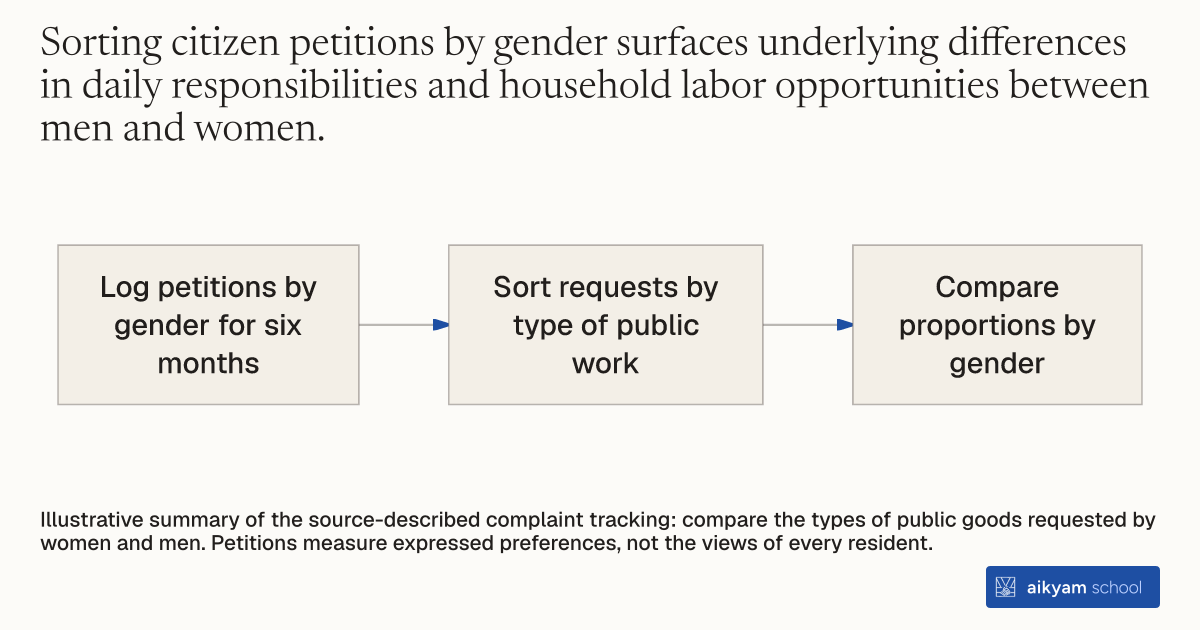
- Log petitions by gender for six months
- Sort requests by type of public work
- Compare proportions by gender
Illustrative summary of the source-described complaint tracking: compare the types of public goods requested by women and men. Petitions measure expressed preferences, not the views of every resident.
See source →How
When to use
Policy makers often assume men and women share identical priorities for local public infrastructure investments. Male-dominated local councils may fail to recognize gender-specific development gaps in rural communities. Tracking formal citizen requests and complaints sorted by gender reveals distinct policy preferences across different groups.
Collect and systematically log formal citizen requests brought to local council leaders to identify gender-differentiated policy priorities.
- Require council presidents to record every formal petition and complaint submitted by citizens during office hours over a six-month period.
- Log the gender of each petitioner along with the specific public good requested in their complaint.
- Categorize complaints into distinct public works areas including drinking water, road repair, housing, electricity, education, and irrigation.
- Calculate the proportion of total complaints submitted by women versus men for each public goods category.
- Identify the infrastructure gaps with the largest positive difference between female and male petition rates to inform local budget priorities.
Example
In West Bengal, formal complaint tracking revealed that 31% of women petitioned for drinking water and 31% petitioned for roads, whereas 20% of men petitioned for irrigation and 17% for water.
About the study
Participants
265 village councils (165 in West Bengal and 100 in Rajasthan) covering rural populations of 10,000 residents per council.
Study Design
Survey logging formal complaints brought to council heads in the preceding six months, disaggregated by gender of petitioner and public good type.
Results
In West Bengal, 31% of female complaints targeted drinking water versus 17% for men (+13% gap), while in Rajasthan, 54% of female complaints targeted water compared to 43% for men (+9% gap).