Try, learn and adjust
Check forest payments follow verified tree cover
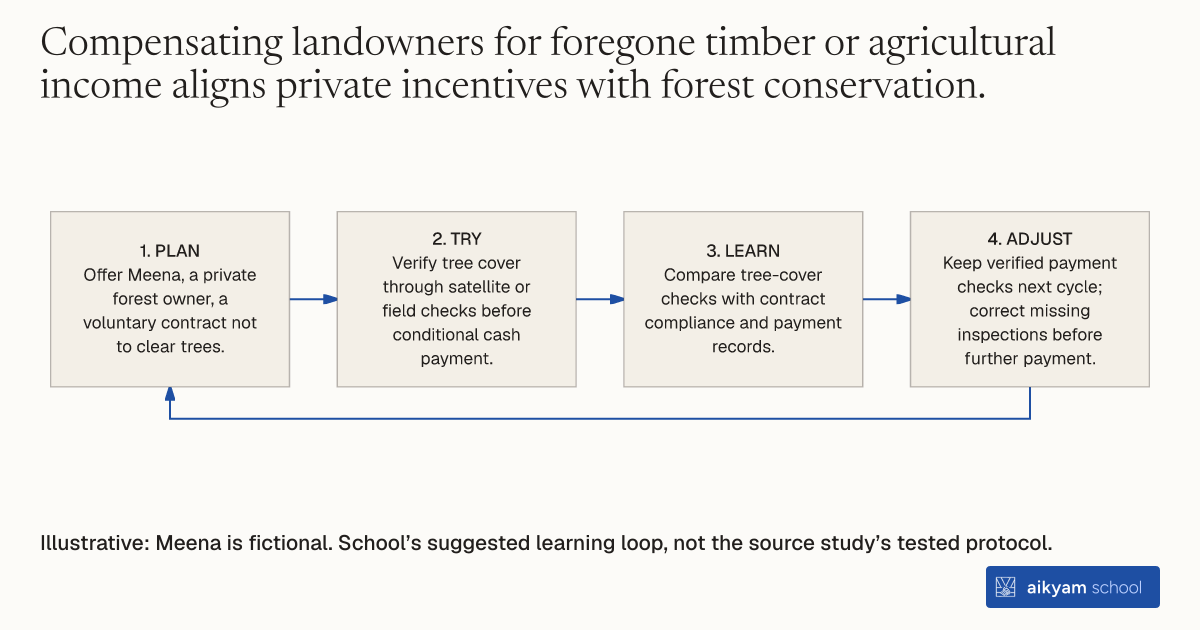
- Plan: Offer Meena, a private forest owner, a voluntary contract not to clear trees.
- Try: Verify tree cover through satellite or field checks before conditional cash payment.
- Learn: Compare tree-cover checks with contract compliance and payment records.
- Adjust: Keep verified payment checks next cycle; correct missing inspections before further payment.
Illustrative: Meena is fictional. School’s suggested learning loop, not the source study’s tested protocol.
See source →Tree cover, contract compliance and payment; no assumed amount of avoided clearing. School’s suggested learning loop, not a source-tested cycle.
How
When to use
Private landowners face financial incentives to clear forests for timber sales or agriculture. Unregulated land clearing releases stored carbon dioxide into the atmosphere and destroys biodiversity. This method applies to conservation organizations and governments seeking to avert deforestation through monetary transfers.
Offer forest landowners conditional financial compensation for foregone income to prevent tree cutting on private land.
- The conservation authority identifies private landowners holding forested acreage in targeted deforestation zones.
- The authority designs a payment contract offering cash compensation to landowners who preserve their trees.
- Landowners voluntarily sign payments for ecosystem services contracts agreeing not to clear forested areas.
- Monitoring teams verify tree cover compliance across participating properties using satellite or field inspections.
- The authority distributes conditional monetary transfers to compliant landowners to offset foregone agricultural income in Uganda.
Why it works
Financial compensation turns standing trees into a source of income, reducing economic pressure to log private lands.
Example
In Uganda, a local nonprofit offered private landowners payments to not cut trees on their property, which reduced forest clearing from 9 percent in control villages to 4 percent among contract holders.
About the study
Participants
Private forest landowners across villages in Uganda.
Study Design
Randomized controlled trial evaluating payments for ecosystem services contracts offering cash compensation to prevent tree cutting.
Results
Landowners offered contracts cleared 4 percent of forested land compared to 9 percent in control villages, delaying 3,000 metric tons of carbon dioxide per village at a cost of US\$0.46 per metric ton.