Research procedure
Compare conservation payments with social savings
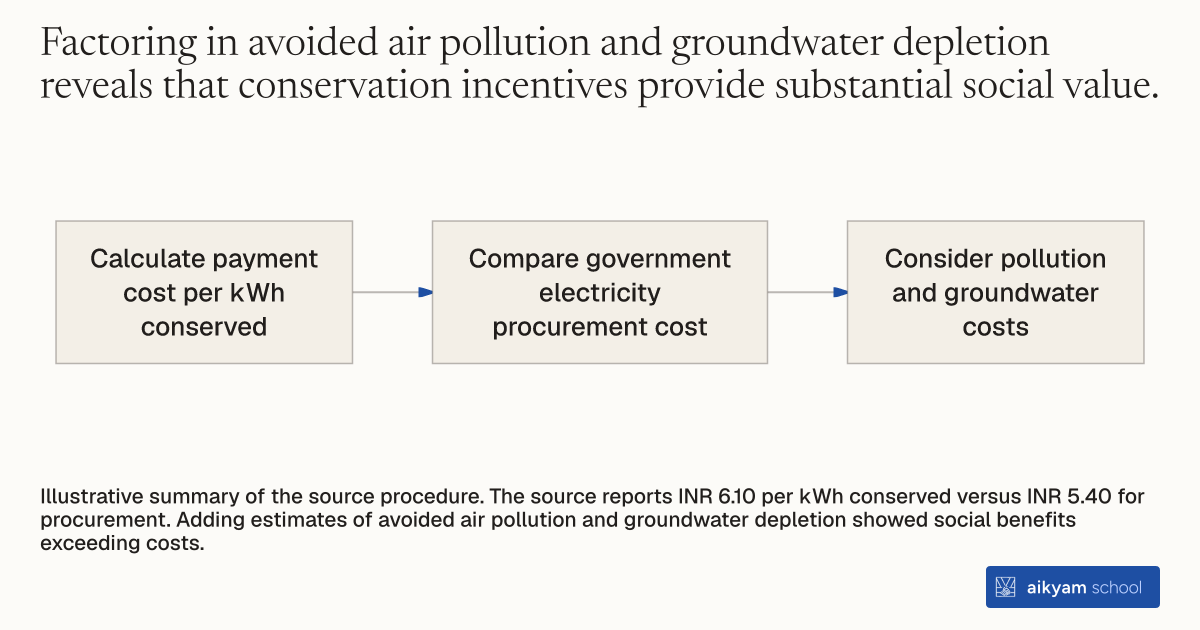
- Calculate payment cost per kWh conserved
- Compare government electricity procurement cost
- Consider pollution and groundwater costs
Illustrative summary of the source procedure. The source reports INR 6.10 per kWh conserved versus INR 5.40 for procurement. Adding estimates of avoided air pollution and groundwater depletion showed social benefits exceeding costs.
See source →How
When to use
Evaluating resource conservation incentives solely against direct power procurement costs miscalculates program value. Ignoring environmental externalities like aquifer depletion and thermal power emissions leads policymakers to underinvest in conservation payments. This cost-accounting method incorporates environmental externalities alongside electricity generation costs to assess the net public value of resource conservation subsidies.
Evaluate the net financial and social cost-effectiveness of agricultural conservation incentive programs relative to baseline power procurement costs.
- Calculate the direct financial payout cost per kilowatt-hour of electricity conserved by participating farmers.
- Determine government bulk power procurement costs per kilowatt-hour paid to energy producers.
- Quantify environmental externalities saved per kilowatt-hour, including reduced air pollution from power generation and avoided groundwater depletion.
- Add avoided environmental externalities to baseline electricity procurement prices to establish total social savings.
- Compare total social savings against direct incentive program expenditures to evaluate overall policy value.
Why it works
This broader accounting framework demonstrates that subsidizing conservation payments is socially preferable to expanding electricity supply.
Example
Researchers evaluated conservation payments in Saurashtra, Gujarat, finding direct program costs of INR 6.10 per kilowatt-hour conserved compared to government electricity procurement costs of INR 5.40 per kilowatt-hour. Incorporating modest estimates of reduced air pollution and groundwater depletion showed that conservation payments were socially welfare-enhancing.
About the study
Participants
1,111 smallholder farmers in Saurashtra, Gujarat, India.
Study Design
Economic cost-benefit analysis comparing direct payment costs against bulk power procurement prices and environmental externality estimates within an RCT evaluating five randomized treatment arms from December 2022 to March 2023.
Results
Direct program costs averaged INR 6.10 per kilowatt-hour conserved versus an electricity procurement cost of INR 5.40 per kilowatt-hour; adding modest estimates of avoided air pollution and groundwater depletion made conservation payments socially welfare-enhancing compared to expanding power supply.