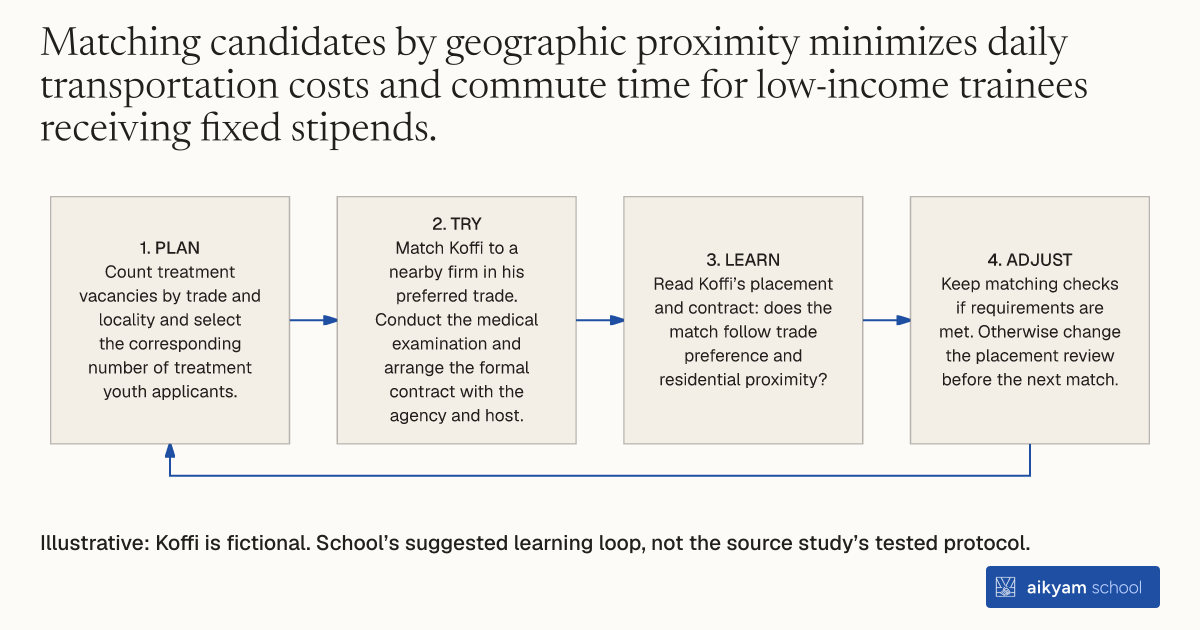
Try, learn and adjust
Check trade and distance in apprenticeship matching
- Plan: Count treatment vacancies by trade and locality and select the corresponding number of treatment youth applicants.
- Try: Match Koffi to a nearby firm in his preferred trade. Conduct the medical examination and arrange the formal contract with the agency and host.
- Learn: Read Koffi’s placement and contract: does the match follow trade preference and residential proximity?
- Adjust: Keep matching checks if requirements are met. Otherwise change the placement review before the next match.
Illustrative: Koffi is fictional. School’s suggested learning loop, not the source study’s tested protocol.
See source →School’s suggested, untested loop: observe trade alignment, proximity, medical examination and signing; no start or retention rate is assumed.
How
When to use
Unemployed youth and informal microenterprises often struggle to match efficiently due to information asymmetries and geographic friction. Public training agencies need a structured matching mechanism to place eligible applicants in host firms within their preferred trade and nearby neighborhood. Matching selected candidates based on trade interest and residence proximity reduces commute costs and prevents early placement dropouts.
Match eligible youth applicants to selected host microenterprises using trade specialization alignment and residential proximity.
- Count verified apprenticeship vacancies offered by treatment host firms in each trade within a target urban locality.
- Select an equal number of eligible youth applicants assigned to treatment in the corresponding locality and trade.
- Map the residential address of each selected youth relative to the physical workplace location of treatment firms offering vacancies in that trade.
- Have national training counselors match each youth to a nearby host enterprise in their preferred trade based on minimum distance.
- Conduct medical examinations for matched candidates and facilitate formal apprenticeship contract signing between youth, host enterprise owners, and the implementation agency.
Why it works
Aligning placements with stated trade preferences ensures trainee motivation and reduces early dropout rates during long-term apprenticeships.
Example
National training counselors in Côte d'Ivoire matched 911 selected low-skilled youth applicants to 361 treatment microenterprises across 7 urban localities based on trade preferences and local proximity, resulting in 72.3 percent of assigned youth signing contracts and starting formal dual apprenticeships.
About the study
Participants
911 treatment youth applicants (87 percent male, average age 20.7 years) and 361 treatment microenterprises across 7 urban localities in Côte d'Ivoire.
Study Design
Stratified double-sided randomized experiment matching selected treatment youth to treatment firms by micro market (trade within locality).
Results
Matching youth to local host firms yielded an 83.4 percent contract signature rate among contacted candidates and a 74.7 percent apprenticeship start rate, establishing 1.398 formal apprentice placements per enterprise.