Research procedure
Screen apprenticeship applicants
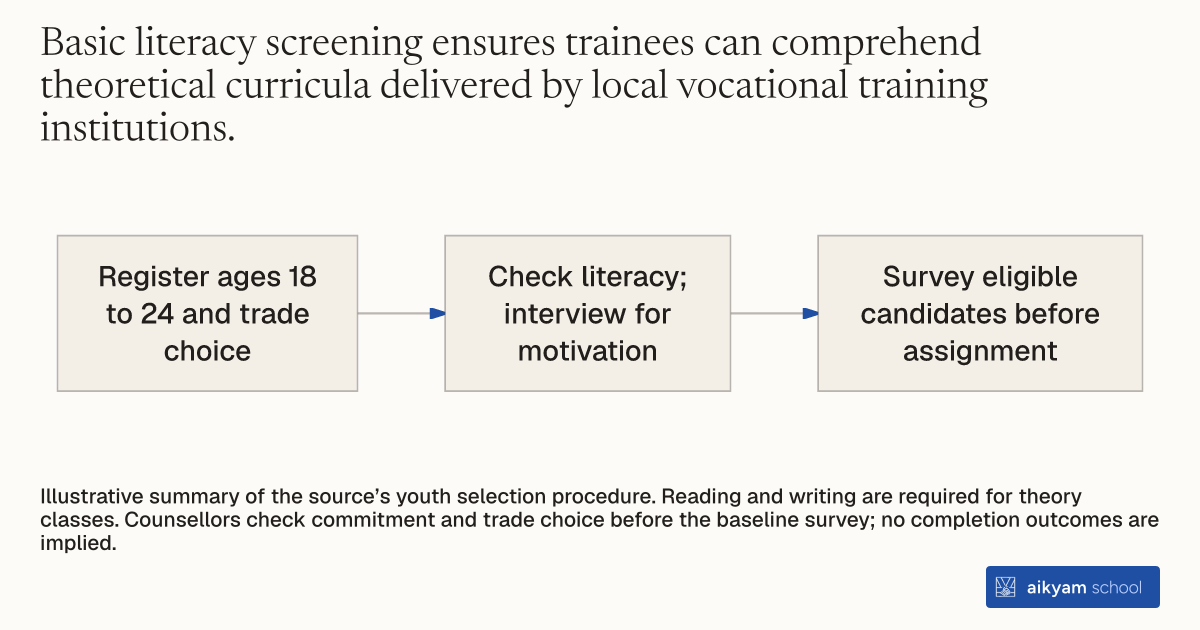
- Register ages 18 to 24 and trade choice
- Check literacy; interview for motivation
- Survey eligible candidates before assignment
Illustrative summary of the source’s youth selection procedure. Reading and writing are required for theory classes. Counsellors check commitment and trade choice before the baseline survey; no completion outcomes are implied.
See source →How
When to use
Low-skilled young people in developing countries often leave school early without job qualifications or steady work. Public vocational programs need to find motivated candidates who possess basic literacy to complete technical courses. Screening applicants through standardized criteria and interviews ensures training resources reach youth who can benefit from classroom instruction.
Select low-skilled youth applicants for formal dual apprenticeships through age verification, literacy checks, and counselor motivation interviews.
- Invite youth aged 18 to 24 in participating urban areas to visit a registration center and submit an application stating their trade preference.
- Filter applications to verify basic eligibility criteria, requiring reading and writing skills needed for theoretical classroom training.
- Conduct individual motivation interviews with eligible applicants using national training agency counselors to confirm commitment and trade choice.
- Administer a baseline survey to candidates who pass the interview to collect demographic and socioeconomic data before program assignment.
Why it works
Individual interviews identify candidate motivation early, reducing placement mismatches and early dropouts.
Example
The national training agency in Côte d'Ivoire registered 1,842 eligible youth aged 18 to 24 who passed motivation interviews and literacy screening across 7 urban localities. Among 911 youth selected for the program, 74.7 percent started a formal apprenticeship and 53.2 percent completed the full multi-year training.
About the study
Participants
1,842 eligible youth applicants aged 18 to 24 (87 percent male, average age 20.7 years) across 7 urban localities in Côte d'Ivoire.
Study Design
Randomized controlled trial evaluating youth selection and placement into dual apprenticeships across micro markets stratified by locality and trade.
Results
Motivation interviews and eligibility screening yielded an applicant pool where 63 percent had completed primary school and 17 percent lower secondary school; 72.3 percent signed a contract and 53.2 percent completed the entire program.