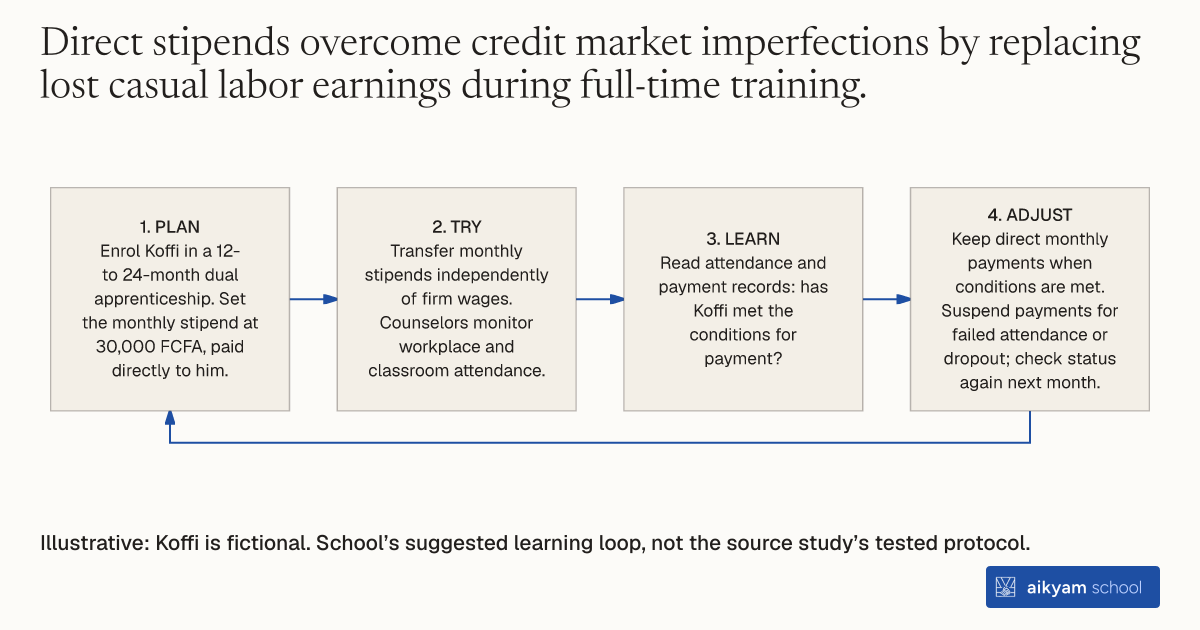
Try, learn and adjust
Check direct monthly trainee stipends
- Plan: Enrol Koffi in a 12- to 24-month dual apprenticeship. Set the monthly stipend at 30,000 FCFA, paid directly to him.
- Try: Transfer monthly stipends independently of firm wages. Counselors monitor workplace and classroom attendance.
- Learn: Read attendance and payment records: has Koffi met the conditions for payment?
- Adjust: Keep direct monthly payments when conditions are met. Suspend payments for failed attendance or dropout; check status again next month.
Illustrative: Koffi is fictional. School’s suggested learning loop, not the source study’s tested protocol.
See source →School’s suggested, untested loop: observe direct payment and attendance conditions; the loop does not establish income or completion effects.
How
When to use
Low-skilled youth in developing economies face severe credit constraints that prevent them from enrolling in long-term vocational training. Unpaid or low-paying traditional apprenticeships require trainees to give up daily casual earnings needed for food and transport. Paying direct monthly living stipends offsets these forgone earnings, allowing vulnerable youth to remain enrolled in multi-year skill programs.
Provide direct monthly living stipends to vocational trainees throughout their multi-year training program.
- Set a fixed monthly stipend amount designed to cover local transport and meal expenses for trainees.
- Enroll eligible low-skilled youth into formal dual apprenticeship contracts with designated training duration from 12 to 24 months.
- Transfer stipend payments directly to trainees each month, independent of host firm wage contributions.
- Deploy field counselors to monitor trainee attendance in both workplace and classroom settings.
- Suspend monthly stipend disbursements if a trainee fails to maintain required attendance or drops out.
Why it works
Paying the stipend directly to trainees rather than through host employers prevents firm capture and guarantees basic subsistence.
Example
In Côte d'Ivoire, the national employment project provided a direct monthly subsidy of 30,000 FCFA (approximately USD 54) to 911 low-skilled youth in 12- to 24-month dual apprenticeships, fully offsetting their 10,494 FCFA monthly forgone labor earnings and enabling 53.2 percent of participants to complete the full multi-year program.
About the study
Participants
1,842 eligible youth applicants (911 treatment, 921 control, 87 percent male, average age 20.7 years) across 7 urban localities in Côte d'Ivoire.
Study Design
Inversely propensity weighted randomized controlled trial measuring short-term labor earnings, non-labor income, and training retention 20 months after baseline.
Results
Short-term labor earnings fell by 10,494 FCFA per month (-25 percent, p < 0.001) due to forgone wage work and self-employment, but non-labor stipend income increased by 10,213 FCFA per month (p < 0.001), fully balancing total monthly income (-1,408 FCFA, p = 0.669) and increasing overall apprenticeship participation by 36.5 percentage points.