Research analysis
Estimate choices without logistic error assumptions
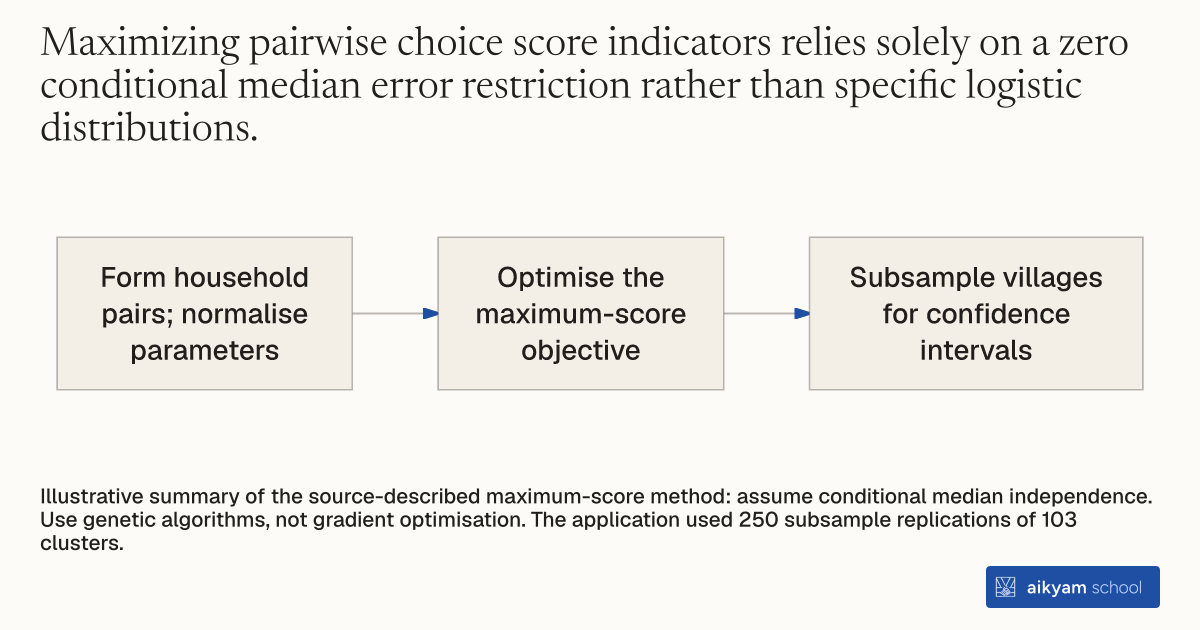
- Form household pairs; normalise parameters
- Optimise the maximum-score objective
- Subsample villages for confidence intervals
Illustrative summary of the source-described maximum-score method: assume conditional median independence. Use genetic algorithms, not gradient optimisation. The application used 250 subsample replications of 103 clusters.
See source →How
When to use
Econometricians and health evaluators need to estimate technology adoption preference parameters without imposing strong parametric distributional assumptions on household error terms. Standard logistic regression models fail if unobserved household preferences interact with observable covariates or suffer from non-classical measurement error. Semi-parametric maximum score estimation with village fixed effects relaxes parametric logistic assumptions by requiring only conditional median independence.
Estimate discrete choice preference parameters while controlling for unobserved cluster heterogeneity by implementing semi-parametric maximum score estimation with subsampling inference.
- Group sample observations into village clusters and form pairwise household comparisons within each cluster.
- Formulate a semi-parametric objective function that maximizes pairwise score indicators comparing household choices and utility index differences.
- Apply location and scale normalizations to identify preference parameters, setting baseline utility constants or specific coefficients to fixed values.
- Optimize the non-differentiable maximum score objective function across village pairs using genetic algorithms or simulated annealing.
- Generate valid confidence intervals and perform inference by drawing repeated cluster-level subsamples rather than standard bootstrap iterations.
Why it works
Subsampling at the cluster level yields consistent inference and valid confidence intervals for non-differentiable maximum score objective functions where traditional bootstrap procedures fail.
Example
Researchers estimated semi-parametric technology adoption parameters across 1,865 households in 129 villages in rural Orissa, India. Using a genetic algorithm and 250 subsample replications with a subsample size of 103 clusters, the model estimated a positive community perception coefficient of 2.53 (95 percent confidence interval 0.63 to 4.57).
About the study
Participants
1,865 households across 129 village clusters in Bargarh, Balangir, Kandhamal, Keonjhar, and Sambalpur districts in Orissa, India, where 93 percent belong to Scheduled Castes, Scheduled Tribes, or Other Backward Castes.
Study Design
Semi-parametric maximum score fixed-effects model with location and scale normalizations, optimized via genetic algorithms and evaluated using cluster-level subsampling with 250 replications at subsample size 103.
Results
The semi-parametric point estimate for community bednet perceptions was 2.53 (95% CI 0.63 to 4.57) and malaria status was -1.91 (95% CI -5.10 to -0.18), matching the signs of the parametric conditional logit specification.