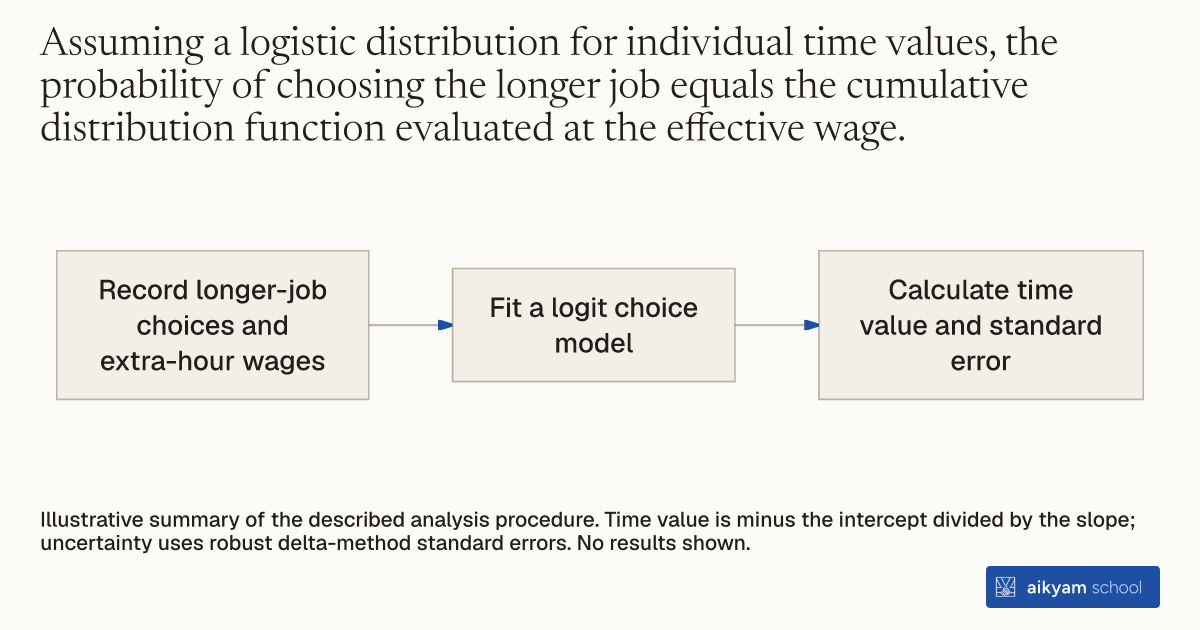
Research steps
Estimate the value of extra hours
- Record longer-job choices and extra-hour wages
- Fit a logit choice model
- Calculate time value and standard error
Illustrative summary of the described analysis procedure. Time value is minus the intercept divided by the slope; uncertainty uses robust delta-method standard errors. No results shown.
See source →How
When to use
Labor economists and public policy analysts need to estimate how workers value non-work time across schedule lengths. Directly measuring reservation wages across specific work hour bundles is challenging because individual shadow values of time are unobserved. This econometric method provides empirical researchers with a framework to back out mean marginal values of time from discrete job choice observations.
Estimate the mean marginal value of time across discrete work-hour bundles using a logit discrete choice specification.
- Define a binary choice indicator that equals one when an applicant selects the longer position of h hours over the shorter position of h minus 5 hours.
- Calculate the effective hourly wage for the additional five hours offered in the longer job option.
- Regress the binary choice indicator on the effective wage using a maximum likelihood logistic regression model to obtain intercept parameter beta zero and slope parameter beta one.
- Calculate the average marginal value of time by dividing negative one times the estimated intercept coefficient by the slope coefficient.
- Compute robust standard errors for the resulting marginal value of time estimate using the delta method.
Why it works
The point where choice probability equals fifty percent identifies the exact wage where the average applicant is indifferent between working additional hours and keeping leisure.
Example
Researchers evaluated choices made by 153 unemployed applicants across 80 U.S. metropolitan areas choosing between 20-hour and 25-hour weekly job options. Dividing the estimated logit intercept parameter by the slope parameter yielded a mean marginal value of time of \$8.95 per hour for the final five work hours.
About the study
Participants
N = 1,152 unemployed job applicants (83% female, average age 32.7 years) across 80 U.S. metropolitan areas.
Study Design
Randomized field experiment presenting job seekers with discrete choices between two job options differing by 5 weekly hours and randomized effective wages, estimated via logit maximum likelihood models.
Results
Logistic model estimation revealed mean marginal time values rising from \$4.80 for 5 to 10 hours, to \$8.95 for 20 to 25 hours, \$12.00 for 35 to 40 hours, and \$21.89 for 40 to 45 hours, yielding a combined pre-tax non-work flow value of 0.58 (s.e. = 0.04).