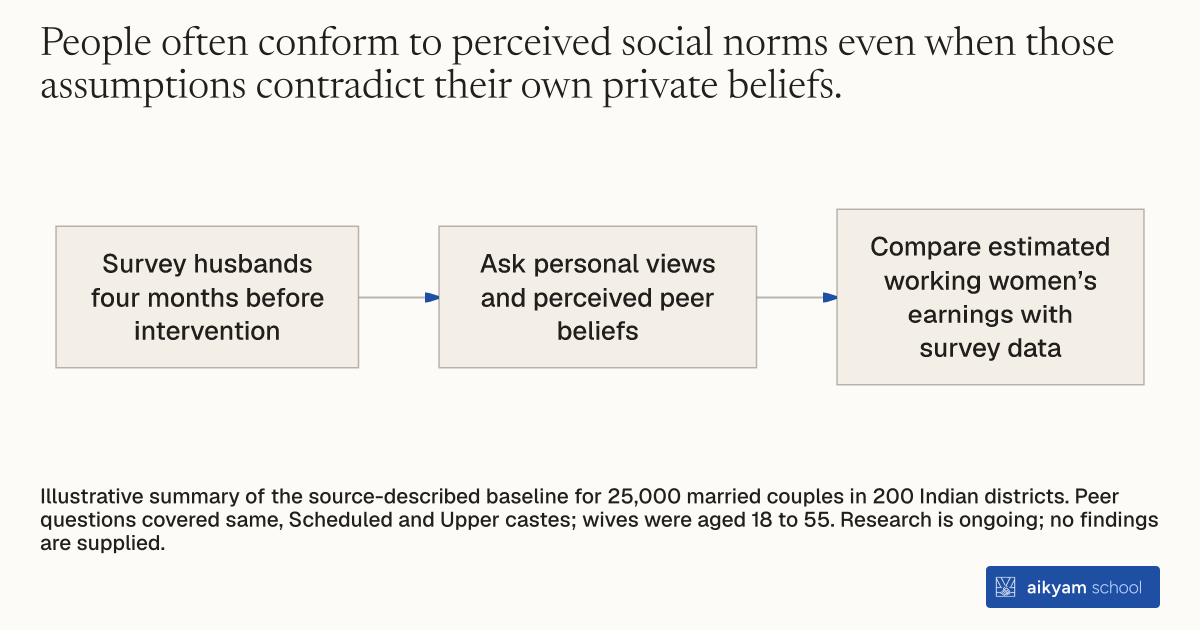
Research steps
Measure personal and perceived gender norms
- Survey husbands four months before intervention
- Ask personal views and perceived peer beliefs
- Compare estimated working women’s earnings with survey data
Illustrative summary of the source-described baseline for 25,000 married couples in 200 Indian districts. Peer questions covered same, Scheduled and Upper castes; wives were aged 18 to 55. Research is ongoing; no findings are supplied.
See source →How
When to use
Female labor force participation in India is among the lowest in the world and continues to decline. Restrictive gender stereotypes and inaccurate assumptions about community attitudes prevent men from supporting working wives. This method diagnoses the gap between personal beliefs and perceived social norms across caste lines for married households.
Measure baseline gender beliefs and norm misperceptions by surveying married men about personal views and perceived community attitudes across caste groups.
- Researchers select a nationally representative sample of 25,000 married couples across 200 districts in urban and rural India.
- Field staff interview husbands during the baseline wave four months before implementing any information intervention.
- Surveyors record each husband's personal views about gender roles and female labor market participation.
- Surveyors ask each husband what he believes other men believe about those same gender roles.
- Field staff gather these peer belief estimates for men of the same caste, scheduled castes, and upper castes.
- Researchers collect husbands' estimates of local working women's earnings and compare them to actual survey data.
Why it works
Identifying misperceptions reveals hidden community support for female employment and establishes a baseline for norm-correcting interventions.
Example
Researchers surveyed 25,000 married couples across 200 districts in India to measure how husbands perceived community gender norms across same, scheduled, and upper castes.
About the study
Participants
25,000 married couples with working-age wives (18 to 55 years old) across 200 districts in urban and rural India.
Study Design
Randomized evaluation baseline survey (Wave 1) measuring personal views, peer belief misperceptions across castes, and earnings estimates four months prior to intervention.
Results
Research ongoing with baseline data collected across 25,000 couples; results forthcoming.