Research steps
Screen drivers before medical assessment
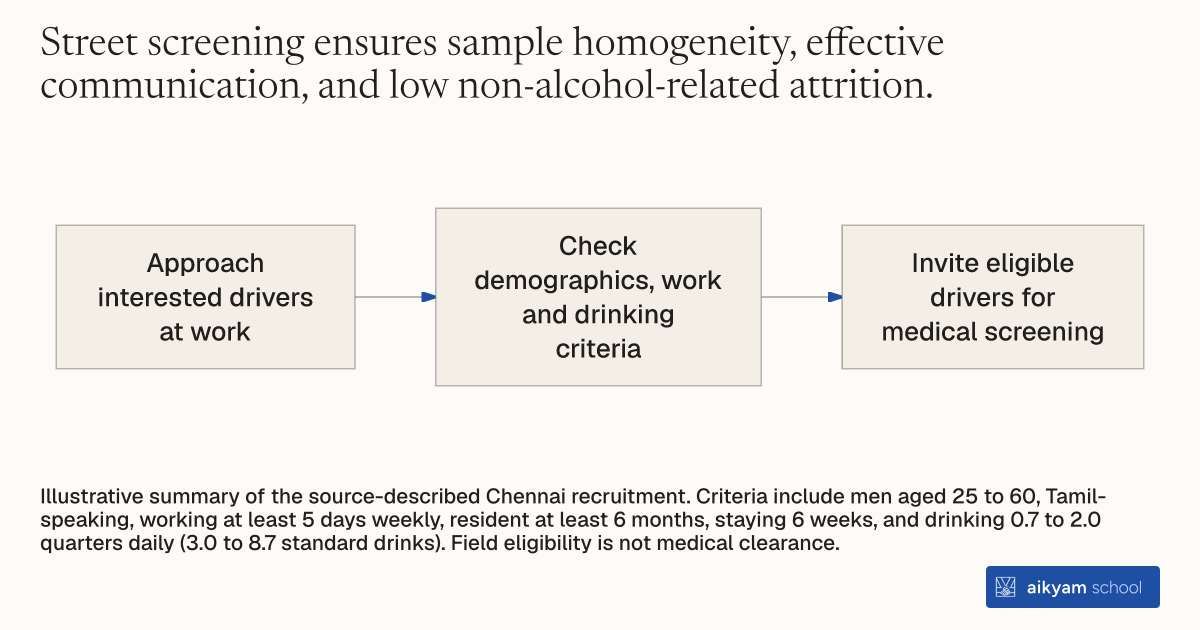
- Approach interested drivers at work
- Check demographics, work and drinking criteria
- Invite eligible drivers for medical screening
Illustrative summary of the source-described Chennai recruitment. Criteria include men aged 25 to 60, Tamil-speaking, working at least 5 days weekly, resident at least 6 months, staying 6 weeks, and drinking 0.7 to 2.0 quarters daily (3.0 to 8.7 standard drinks). Field eligibility is not medical clearance.
See source →How
When to use
Research projects need to identify and enroll a target population of male manual laborers with specific alcohol consumption levels. This method addresses the challenge of efficiently filtering candidates to create a homogenous sample while screening out light drinkers and individuals at risk of alcohol withdrawal. Use this approach for recruiting working-class men into multi-week field studies near their daily work locations.
Conduct a brief structured screening survey near participants' work locations to identify eligible candidates for study participation.
- Field surveyors approach male cycle-rickshaw drivers near the study office during regular work hours.
- Surveyors ask interested drivers to complete a short eligibility questionnaire for a paid study.
- Surveyors verify basic demographic and work criteria: male aged 25 to 60, Tamil speaker, pulling rickshaws at least 5 days per week, and living in Chennai for at least 6 months with no plans to leave for 6 weeks.
- Surveyors measure self-reported daily alcohol consumption, verifying that the driver consumes 0.7 to 2.0 quarters of hard liquor (3.0 to 8.7 standard drinks) per day.
- Surveyors invite eligible individuals who meet all field criteria to visit the study office for detailed medical screening.
Why it works
Establishing upper and lower drinking bounds guarantees sufficient alcohol consumption for treatment impact while excluding severe drinkers vulnerable to dangerous withdrawal symptoms.
Example
Field surveyors approached prospective male cycle-rickshaw drivers near the study office in Chennai between April and September 2014. Sixty percent of approached drivers satisfied the eligibility criteria—aged 25 to 60, Tamil-fluent, working 5+ days per week, living in Chennai for 6+ months, and drinking 0.7 to 2.0 quarters of hard liquor daily—and agreed to visit the study office for further screening.
About the study
Participants
Male cycle-rickshaw drivers aged 25 to 60 working in central Chennai, India.
Study Design
On-street structured screening survey administered during work hours on a rolling basis.
Results
60 percent of screened candidates met eligibility criteria and agreed to visit the study office; 15 percent declined to participate, 12 percent lost interest, and the remainder were excluded primarily for consuming under 3 standard drinks daily or being abstinent.