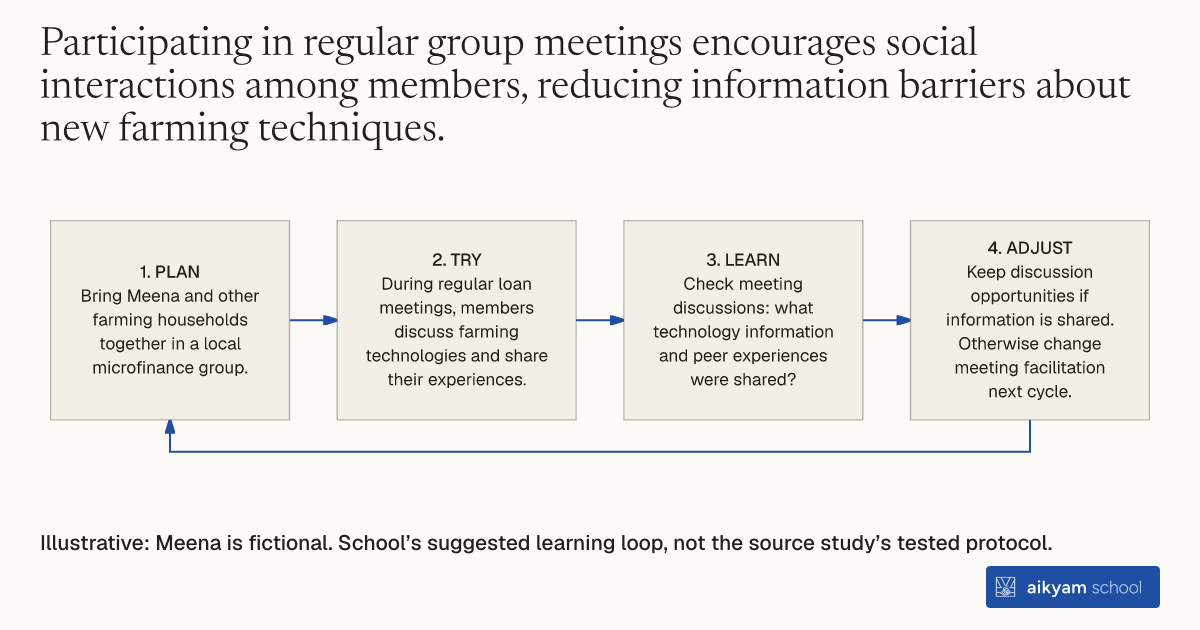
Try, learn and adjust
Check farming information is shared in loan groups
- Plan: Bring Meena and other farming households together in a local microfinance group.
- Try: During regular loan meetings, members discuss farming technologies and share their experiences.
- Learn: Check meeting discussions: what technology information and peer experiences were shared?
- Adjust: Keep discussion opportunities if information is shared. Otherwise change meeting facilitation next cycle.
Illustrative: Meena is fictional. School’s suggested learning loop, not the source study’s tested protocol.
See source →School’s suggested, untested learning loop. Observe information sharing and social interactions. Whether this increases adoption remains to be established.
How
When to use
Smallholder farmers in rural Tamil Nadu often fail to adopt productive agricultural technologies due to a lack of information. Conventional information channels may not reach rural populations effectively. Organizing farmers into microfinance groups provides a platform where peers discuss and share knowledge about new agricultural techniques.
Organize rural farmers into microfinance groups to facilitate peer-to-peer sharing of agricultural information.
- Financial institutions gather rural farming households into local microfinance borrower groups.
- Group members meet regularly to manage shared microfinance loans and financial services.
- Participating farmers discuss and share information about new farming technologies during group interactions.
- Farmers learn from peer experiences to reduce uncertainty and adopt productive agricultural methods.
Why it works
Learning from trusted peers lowers the perceived risk of adopting unfamiliar agricultural technologies.
Example
Researchers evaluated how microfinance group meetings in Thanjavur, Tamil Nadu encouraged 4,500 to 5,500 rural households to share information about new farming tools to overcome adoption bottlenecks.
About the study
Participants
4,500 to 5,500 households served by 100 to 120 planned rural financial service branches in Thanjavur, Tamil Nadu, India.
Study Design
Phased randomized controlled trial evaluating 50 to 60 early branch areas against 50 to 60 delayed expansion control areas using baseline and endline household surveys measuring social interactions and technology adoption.
Results
Per capita income in Tamil Nadu was US\$1,271 in 2008 with formal credit access at 27 percent in 2003, and technology adoption findings are listed as forthcoming.