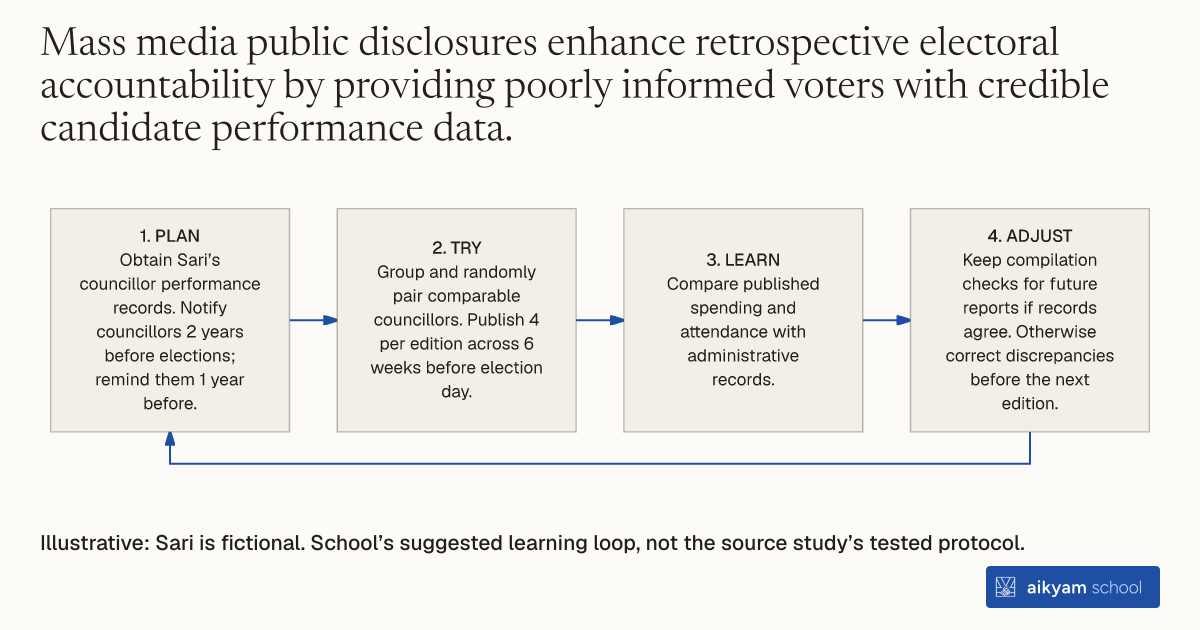
Try, learn and adjust
Check pre-election reports against official records
- Plan: Obtain Sari’s councillor performance records. Notify councillors 2 years before elections; remind them 1 year before.
- Try: Group and randomly pair comparable councillors. Publish 4 per edition across 6 weeks before election day.
- Learn: Compare published spending and attendance with administrative records.
- Adjust: Keep compilation checks for future reports if records agree. Otherwise correct discrepancies before the next edition.
Illustrative: Sari is fictional. School’s suggested learning loop, not the source study’s tested protocol.
See source →School’s suggested learning loop: observe report accuracy and publication timing. School’s loop does not change the study’s random pairing or establish election effects.
How
When to use
Voters in low-income urban neighborhoods often lack reliable data on how local elected officials spend public funds and attend legislative meetings. Elected councilors frequently allocate discretionary funds toward visible infrastructure projects rather than high-priority constituent needs like sanitation. Publishing verified performance report cards in high-circulation newspapers prior to elections informs voters and creates strong electoral incentives for politicians.
Inform councilors in advance that objective performance data will be published in a major daily newspaper right before the next municipal election.
- Obtain administrative data on councilor spending, assembly attendance, and committee membership using Right-to-Information Act requests.
- Send official notification letters to selected councilors two years before elections to explain that performance report cards will be published in a major daily newspaper prior to the vote.
- Send a written reminder letter to the selected councilors one year before the elections.
- Categorize councilors into comparable ward groups by geographic zone, incumbent eligibility status, and slum density, then randomly pair them.
- Compile individual report cards displaying the councilor photograph, committee attendance, assembly attendance, and category-wise discretionary spending.
- Publish performance report cards daily in a major newspaper across six weeks prior to election day, featuring four councilors per edition.
Why it works
Politicians anticipate that voters and political parties will reward strong performance at the polls, motivating them to align spending with constituent priorities.
Example
In Delhi, India, an NGO and the newspaper Dainik Hindustan published pre-election report cards for municipal councilors before the April 2012 elections. Treated councilors in high-slum-density wards increased pro-poor spending by 0.656 standard deviations relative to low-slum-density wards. Ineligible treated councilors with strong pro-poor spending records were 16 percentage points more likely to receive party tickets to run in other wards compared to control counterparts.
About the study
Participants
240 municipal wards in Delhi, India, covering millions of residents including 5,481 surveyed slum households across 107 high-slum-density wards.
Study Design
A randomized controlled trial across 240 wards, where 168 councilors were randomly assigned to pre-election report card treatment arms and 72 wards served as controls.
Results
Treated councilors in high-slum-density wards increased pro-poor spending allocations by 0.656 standard deviations (p = 0.03). High-performing ineligible treated councilors were 13 percentage points more likely to receive a party ticket for every one standard deviation increase in pro-poor spending (p = 0.03) and earned a 9 percentage point higher vote share (p = 0.05).