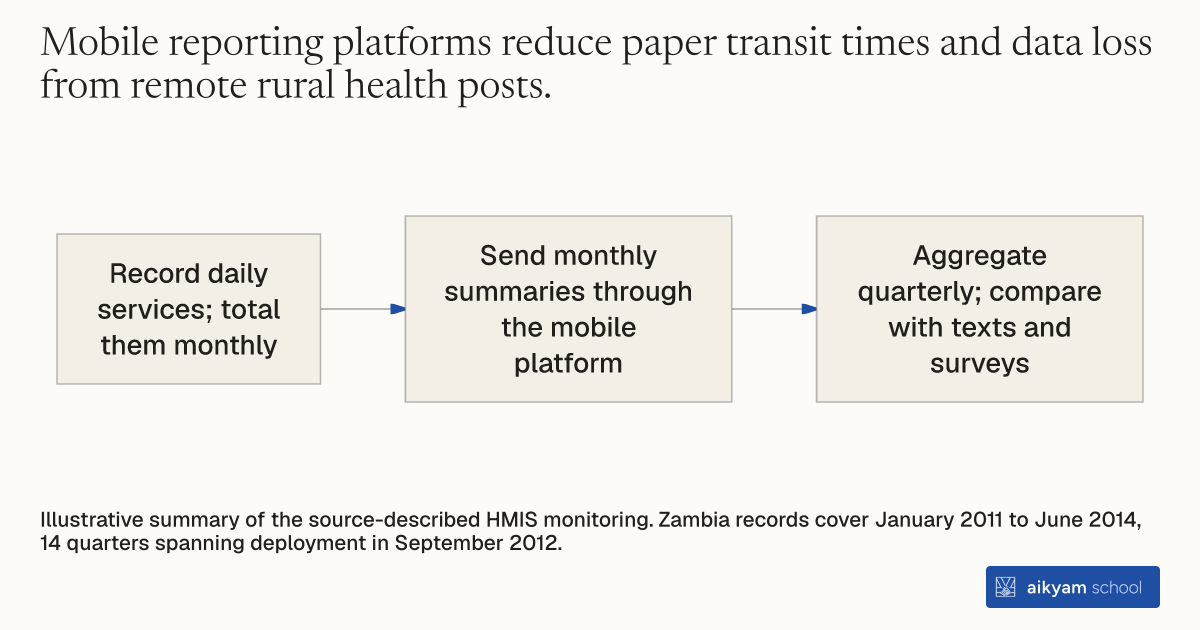
Research steps
Build facility use records
- Record daily services; total them monthly
- Send monthly summaries through the mobile platform
- Aggregate quarterly; compare with texts and surveys
Illustrative summary of the source-described HMIS monitoring. Zambia records cover January 2011 to June 2014, 14 quarters spanning deployment in September 2012.
See source →How
When to use
Rural health facilities need to transmit administrative utilization data to central authorities to evaluate healthcare delivery and health post output. Paper reports often suffer from transit delays, missing monthly records, or data entry errors in remote districts. Digitizing facility reporting through a mobile health management platform collects reliable monthly administrative health data across distributed clinic networks.
Monitor health post utilization and service delivery by transmitting monthly administrative health records via a mobile electronic reporting platform.
- Primary health staff and community health workers record daily client service visits, childbirths, and child weighings in health facility logs.
- Facility staff aggregate daily service figures into monthly summary totals at the end of each calendar month.
- Health post personnel transmit monthly administrative summaries electronically to the central Ministry of Health using a mobile reporting platform.
- Central data managers aggregate facility submission records across rural health posts and health centers into quarterly reporting periods.
- Program evaluators compare monthly facility utilization reports against individual SMS service logs and independent household surveys to verify operational health trends.
Why it works
Continuous electronic data collection provides central ministries with verified facility utilization metrics to track maternal and child health trends across rural districts.
Example
In rural Zambia, staff across rural health posts and health centers transmitted monthly HMIS health utilization data via a mobile platform from January 2011 through June 2014. HMIS facility records tracked service outputs across 14 quarters before and after Community Health Assistants arrived. Facilities in career treatment districts recorded a 30 percent increase in institutional deliveries, a 24 percent increase in child health visits, and a 22 percent increase in child weighings relative to control facility means.
About the study
Participants
Health posts and health centers serving rural catchment areas across 48 districts in Zambia (89 health centers evaluated for deliveries and 123 facilities evaluated for child health visits).
Study Design
Difference-in-differences panel analysis tracking 14 quarters of monthly mobile HMIS facility administrative records (January 2011 to June 2014) before and after health worker deployment in September 2012.
Results
Career treatment increased health center institutional childbirths by 30 percent (13.65 additional births per quarter relative to 45.3 control baseline mean, p=0.038), child health visits by 24 percent (312.1 additional visits per quarter, p=0.003), and child weighings by 22 percent (277.8 additional weighings per quarter, p=0.017), yielding an average standardized treatment effect across facility utilization of 0.278 (p=0.005).