Research steps
Track health markers over the programme
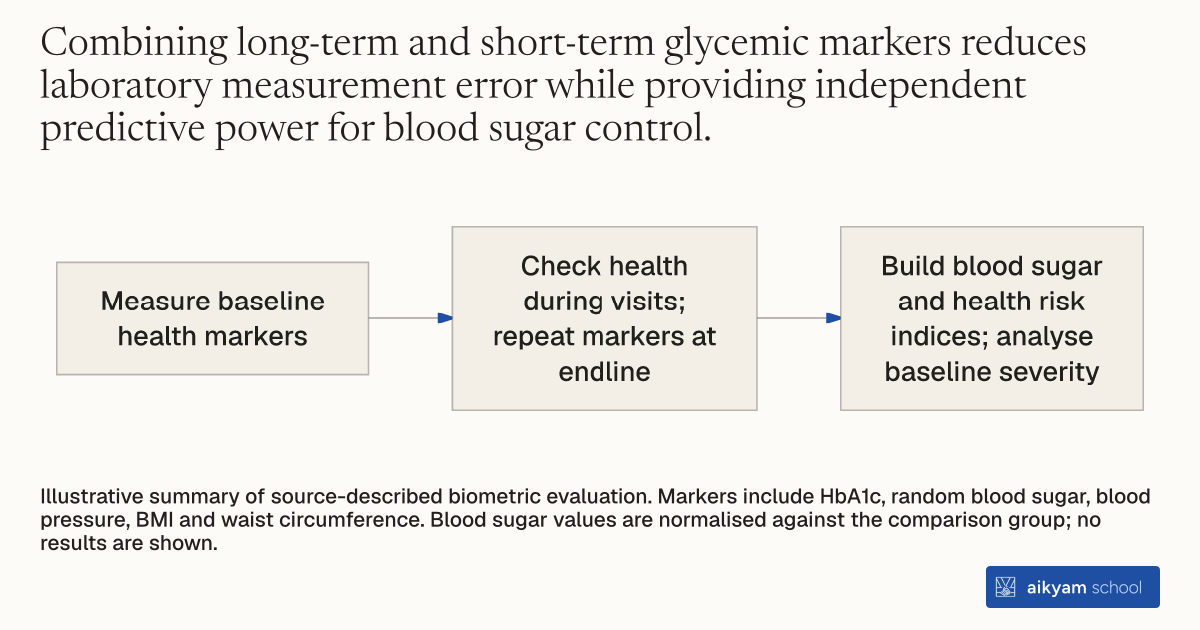
- Measure baseline health markers
- Check health during visits; repeat markers at endline
- Build blood sugar and health risk indices; analyse baseline severity
Illustrative summary of source-described biometric evaluation. Markers include HbA1c, random blood sugar, blood pressure, BMI and waist circumference. Blood sugar values are normalised against the comparison group; no results are shown.
See source →How
When to use
Health behavior programs need to assess whether physical activity interventions produce clinical health improvements in participants with chronic disease. Relying on a single biomarker can introduce measurement noise or fail to capture broader cardiovascular risk reductions. This method serves adult patients with type 2 diabetes or elevated blood sugar undergoing health monitoring interventions.
Evaluate clinical health impacts of lifestyle interventions by collecting blood sugar, cardiovascular, and body composition markers across baseline, mid-program visits, and endline evaluations.
- Administer baseline health measurements prior to program launch to evaluate glycated hemoglobin, random blood sugar, blood pressure, waist circumference, and body mass index.
- Schedule periodic field visits during the intervention period to conduct short health checks and record intermediate random blood sugar readings alongside pedometer data syncing.
- Conduct an endline health survey at the conclusion of the program to re-measure glycated hemoglobin, random blood sugar, blood pressure, body mass index, and waist circumference.
- Construct a standardized blood sugar index by averaging normalized endline glycated hemoglobin and random blood sugar values relative to the comparison group.
- Combine glycemic, blood pressure, body mass index, and waist circumference measures into a standardized health risk index to evaluate overall cardiovascular and metabolic risk reduction.
- Analyze health outcome improvements separately for participants with above-median baseline blood sugar levels to assess clinical responsiveness among severe cases.
Why it works
Aggregating glycemic and body composition metrics into a composite health risk index increases statistical power to detect broad physiological benefits from exercise.
Example
Surveyors evaluated health outcomes for 3,068 participants across Coimbatore, India, following a 12-week exercise incentive program. The incentive intervention improved the composite blood sugar index by 0.05 standard deviations and reduced random blood sugar by 13 mg/dL among participants with above-median baseline blood sugar.
About the study
Participants
3,068 participants evaluated at endline across Coimbatore, India, with an average age of 49.56 years, 42 percent female, 67 percent diagnosed diabetic, 49 percent hypertensive, and an average monthly per capita income of 4,465 INR.
Study Design
A randomized controlled trial evaluating health outcome improvements from exercise incentives relative to control and monitoring groups using baseline, biweekly field checks, and endline biometric surveys measuring glycated hemoglobin, random blood sugar, blood pressure, body mass index, and waist circumference.
Results
Incentives improved the blood sugar index by 0.05 standard deviations and the health risk index by 0.05 standard deviations in the full sample; among participants with above-median blood sugar, incentives reduced the blood sugar index by 0.10 standard deviations and random blood sugar by 12.6 mg/dL.