Try, learn and adjust
Check attendance across monitored clinic days
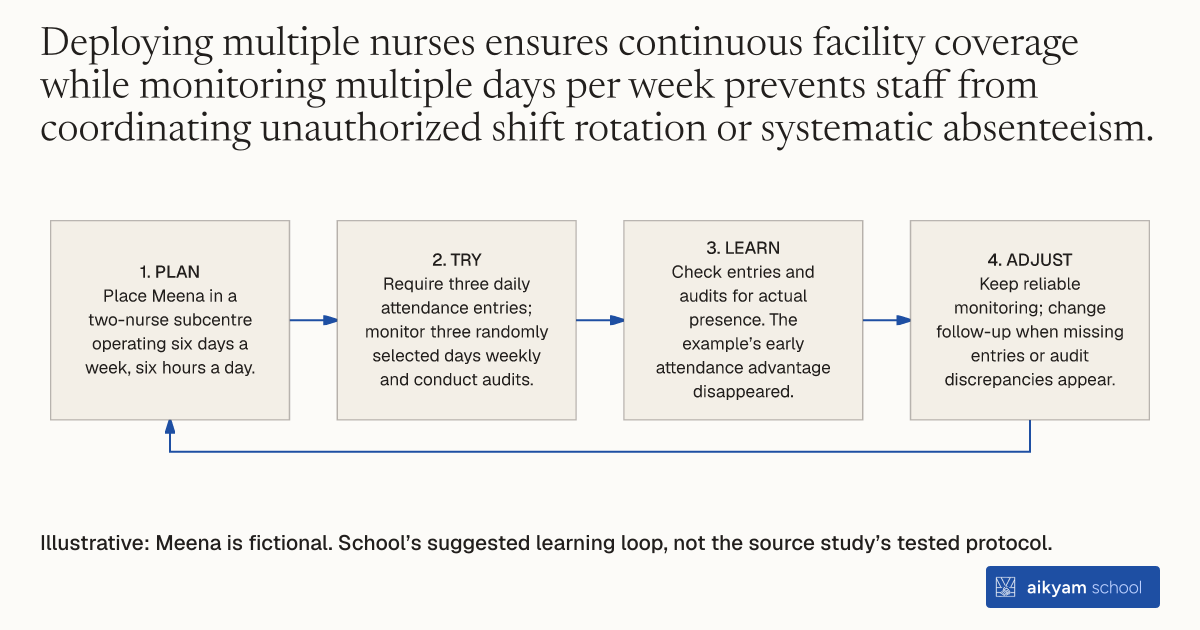
- Plan: Place Meena in a two-nurse subcentre operating six days a week, six hours a day.
- Try: Require three daily attendance entries; monitor three randomly selected days weekly and conduct audits.
- Learn: Check entries and audits for actual presence. The example’s early attendance advantage disappeared.
- Adjust: Keep reliable monitoring; change follow-up when missing entries or audit discrepancies appear.
Illustrative: Meena is fictional. School’s suggested learning loop, not the source study’s tested protocol.
See source →Observe nurse presence, stamped registers and audits; two nurses do not by themselves prove continuous coverage. School suggests this learning loop; it was not tested by the source.
How
When to use
Rural health subcenters staffed by a single provider frequently close when the worker is absent or conducting field duties. Patients arriving for medical care find the facility unattended. Assign multiple nurses to subcenters and monitor attendance across several scheduled days per week to ensure facility availability.
Staff health subcenters with two nurses and conduct multi-day monitoring of attendance.
- Assign two Assistant Nurse Midwives to staff a rural public health subcenter.
- Schedule clinic operating hours across six days a week, six hours a day.
- Require nurses to log presence three times daily using time-stamping machines and wall registers.
- Monitor worker attendance on three randomly selected days each week.
- Apply salary incentives and unannounced audits based on attendance tracked across the monitored days.
Example
In Udaipur District, India, Seva Mandir monitored Assistant Nurse Midwife attendance at 16 randomly selected subcenters staffed by two nurses across three days a week. Monitoring initially increased nurse presence by 15 percentage points over comparison subcenters, though presence fell from over 60 percent to 30 percent after 14 months.
About the study
Participants
Assistant Nurse Midwives at 16 two-nurse public health subcenters serving rural villages in Udaipur District, Rajasthan, India.
Study Design
Randomized controlled trial evaluating multi-day time clock monitoring in subcenters staffed by two nurses compared to unmonitored comparison centers.
Results
Nurse presence was initially 15 percentage points higher in monitored two-nurse centers, but presence declined from over 60 percent to 30 percent after 14 months, eliminating the treatment difference.