Research steps
Monitor steps without exercise rewards
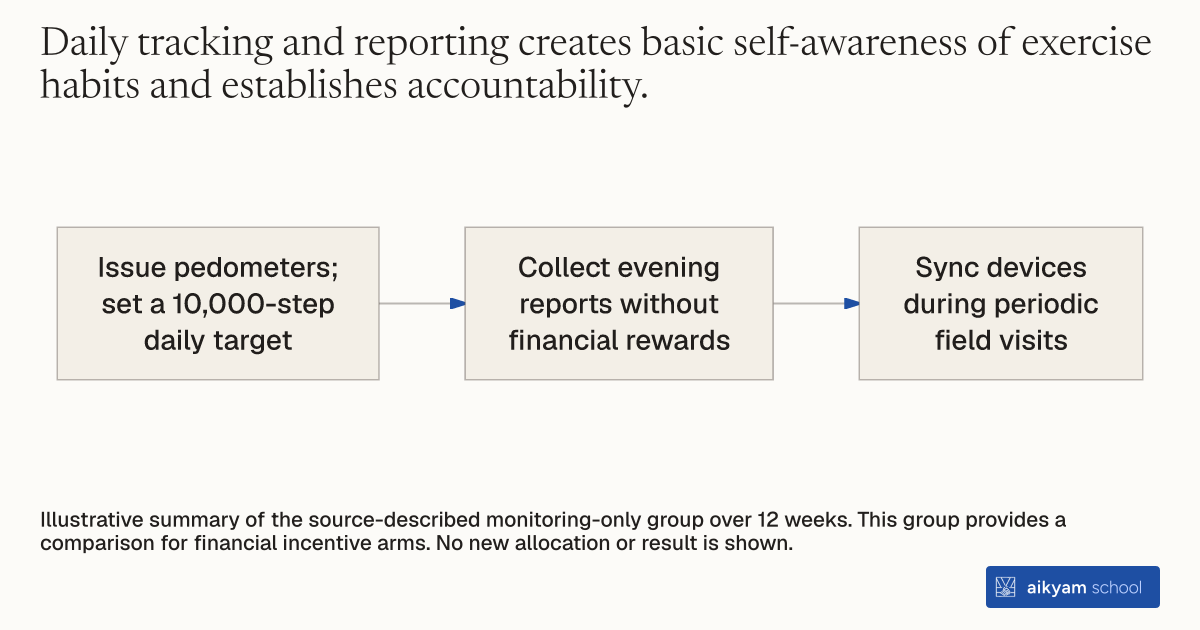
- Issue pedometers; set a 10,000-step daily target
- Collect evening reports without financial rewards
- Sync devices during periodic field visits
Illustrative summary of the source-described monitoring-only group over 12 weeks. This group provides a comparison for financial incentive arms. No new allocation or result is shown.
See source →How
When to use
Health programs managing chronic conditions often need to isolate the effect of self-monitoring from monetary incentives. Distributing pedometers and requiring daily activity logs provides a structured tracking mechanism without financial payouts. This method serves urban diabetics and pre-diabetics participating in physical activity evaluation studies.
Provide participants with activity tracking devices and require daily step reporting without offering monetary rewards.
- Distribute pedometers to program participants to record daily physical activity.
- Instruct participants to wear pedometers throughout the day during routine activities.
- Establish a daily physical activity target of walking 10,000 steps.
- Require participants to submit step count logs every evening through an automated calling system.
- Conduct periodic in-person field visits to sync pedometer devices and verify step data.
Why it works
Operating a non-incentivized monitoring group establishes an active baseline to evaluate the added value of financial reward structures.
Example
In Tamil Nadu, India, researchers assigned a control cohort of urban diabetics and pre-diabetics to a monitoring-only group for twelve weeks. Participants received pedometers and reported daily steps through automated phone calls without receiving financial rewards, achieving the 10,000-step target on 29 percent of days.
About the study
Participants
3,192 urban diabetics and pre-diabetics in Tamil Nadu, India; average age almost 50 years; 58 percent male.
Study Design
12-week randomized controlled trial arm evaluating pedometer tracking and daily reporting without monetary incentives.
Results
Participants in the monitoring-only group reached the 10,000-step target on 29 percent of days, averaging approximately 6,770 steps per day.