Research procedure
Track employment beyond initial placement
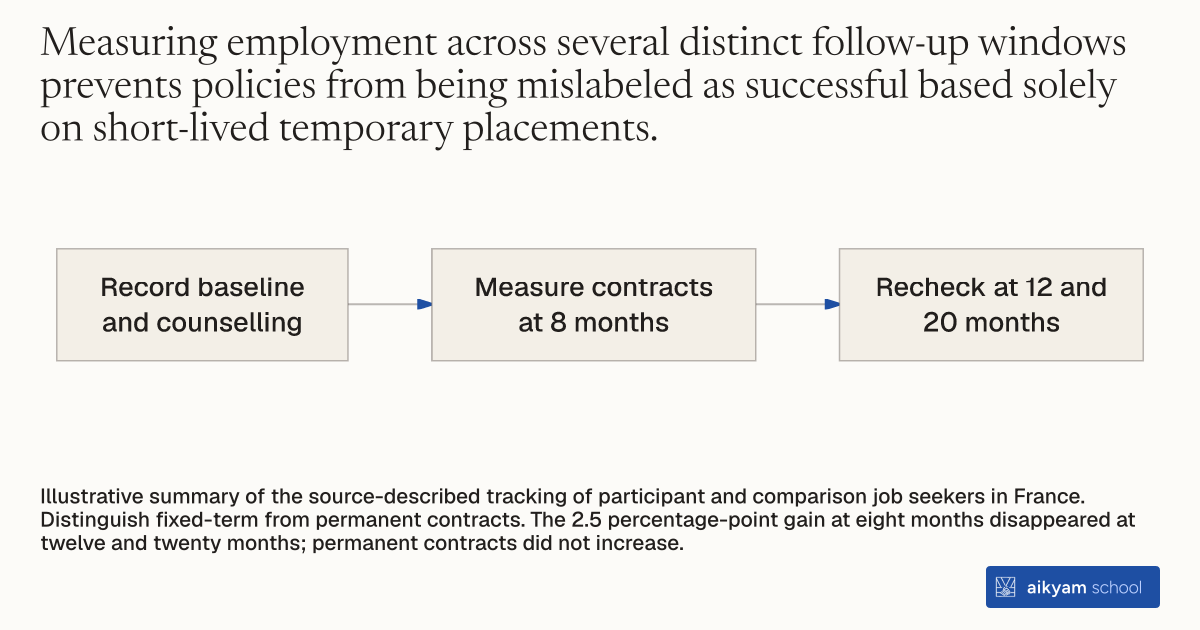
- Record baseline and counselling
- Measure contracts at 8 months
- Recheck at 12 and 20 months
Illustrative summary of the source-described tracking of participant and comparison job seekers in France. Distinguish fixed-term from permanent contracts. The 2.5 percentage-point gain at eight months disappeared at twelve and twenty months; permanent contracts did not increase.
See source →How
When to use
Short-term evaluation metrics often capture temporary job matching while missing long-term decay or non-permanent employment transitions. Tracking employment outcomes across multiple future time horizons enables evaluators to distinguish brief search acceleration from sustained long-term job stability. This method serves labor policy researchers evaluating whether active market interventions create lasting employment increases or temporary contract spikes.
Track participant and comparison group employment outcomes at multiple standardized time intervals following program entry.
- Collect baseline employment and demographic data across eligible job seekers prior to intervention launch.
- Monitor participant activity during counseling including attendance, meeting frequency, and job application support received.
- Record employment status and contract types at eight months following initial counseling offers to measure short-term placement acceleration.
- Distinguish between fixed-term temporary job contracts and permanent employment positions.
- Re-evaluate employment status at twelve and twenty months to determine whether initial employment gains persist or decay over time.
Why it works
Differentiating contract types reveals whether initial placement gains translate into durable career progression.
Example
Between 2007 and 2010 in France, researchers tracked nearly 30,000 young, college-educated job seekers over almost two years at eight, twelve, and twenty months. While treated candidates showed a 2.5 percentage point employment gain at eight months driven by fixed-term contracts, tracking showed all gains disappeared after twelve months with zero increase in permanent contracts.
About the study
Participants
Nearly 30,000 young, college-educated job seekers in their mid-twenties possessing at least a two-year degree and unemployed for at least six months across 235 communities in France.
Study Design
Randomized controlled trial tracking treated and comparison job seekers over almost two years with outcome evaluations conducted at eight, twelve, and twenty months.
Results
At eight months, treated job seekers were 2.5 percentage points more likely to have found long-term jobs driven entirely by fixed-term contracts, but by twelve and twenty months, all employment gains disappeared completely and permanent contracts showed no increase.